- search 4876 views
- file_download 1625 download
- keyboard_capslockmetadata
-
mark_email_readIscriviti alla newsletter
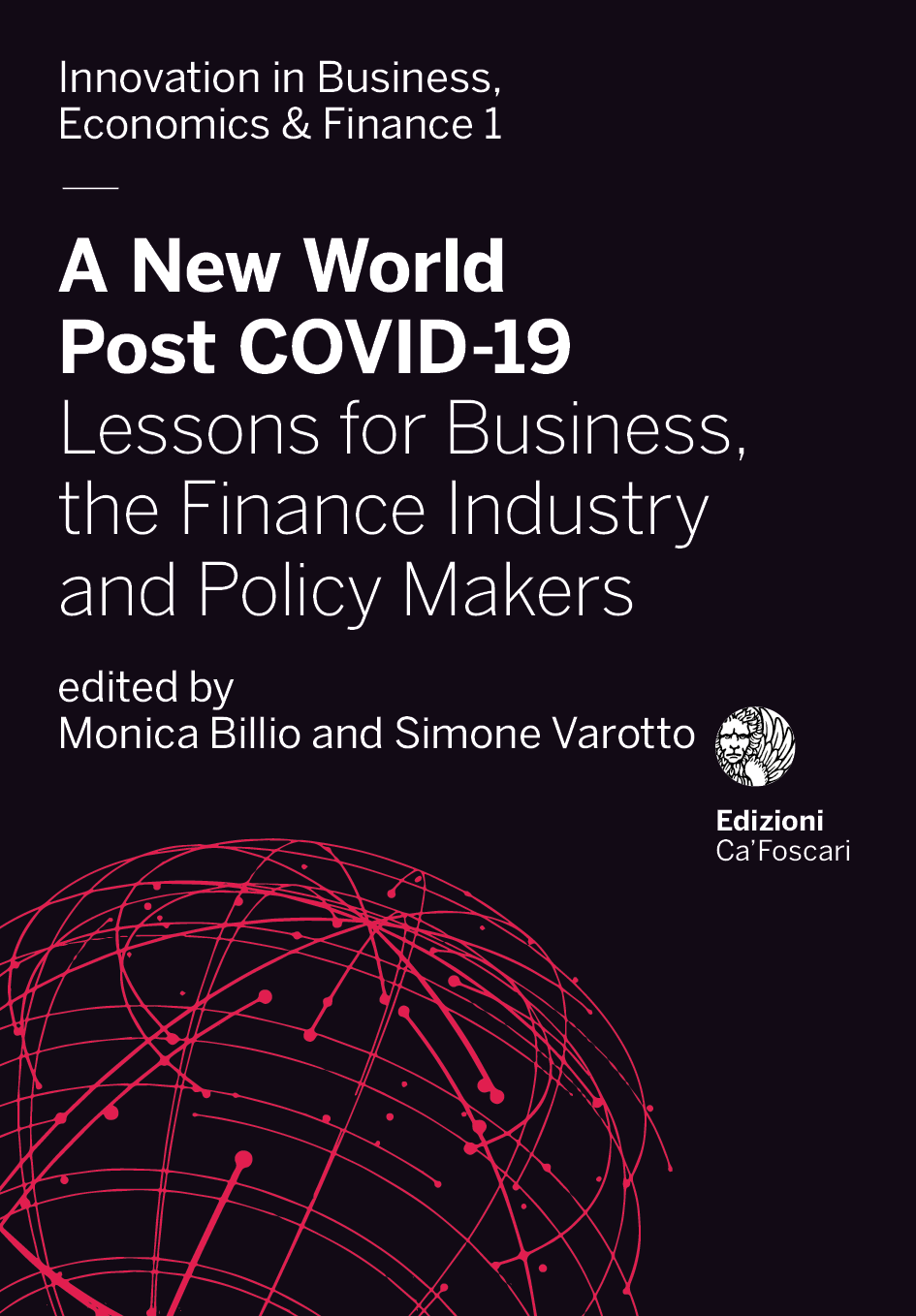
A New World Post COVID-19
Lessons for Business, the Finance Industry and Policy Makers
a cura di
Monica Billio
Università Ca’ Foscari Venezia, Italia

Simone Varotto
ICMA Centre, Henley Business School, University of Reading, UK
abstract
Pandemics are disruptive events that have profound consequences for society and the economy. This volume aims to present an analysis of the economic impact of COVID-19 and its likely consequences for our future. This is achieved by drawing from the expertise of authors who specialise in a wide range of fields including fiscal and monetary policy, banking, financial markets, pensions and insurance, artificial intelligence and big data, climate change, labour market, travel, tourism and politics, among others. We asked contributing authors to write their chapters for a non-technical audience so that their message could reach beyond academia and professional economists to policy makers and the wider society. The material in this volume draws from the latest research and provides a wealth of ideas for further investigations and opportunities for reflection. This also makes it an ideal learning tool for economics and finance students wishing to gain a deeper understanding of how COVID-19 could influence their disciplines.
-
Keywords keyboard_arrow_down
Artificial intelligence • Investment banking • Pandemics • Corporate investments • Collaboration • Digital transformation • Portfolio Optimization • Fiscal policy • Longevity • Data interface • Volatility • Covid-19 • AI • Oil prices • International researchers • Value-at-Risk • Energy supply • Altcoin • Energy demand • Flight-to-quality • Climate change • Local credit • Treasury • Pension withdrawals • Technology impact • Public policy distortions • Sports Management • Italy • Populism • Home production • Investment • Mortality • Tourism • Sovereign Yields • Revenues • Gold • COVID-19 crisis • Coronavirus • Bank risk • Careers • Trade • Decision-making • State pensions • Measurement • Private equity • ECB announcements • Alternative data • Pandemic • Bank default • Festivals • Unemployment • Far right parties • Dynamic Capabilities • Bitcoin • Market risk • Virtual tourism • Repo specialness • Interest Rates • Sports Economics • Start-ups • Travel • CAPM • Debt • Recovery policy • OPEC • Great Depression • Technology • Oil markets • Spillover effects • Equity market performance • Brain circulation • Credit default risk • Acquisitions • COVID-19 pandemic • Skills • Sports Finance • Black Death • Mergers • Country risk • Ambiguity • Incentive compatibility • Political economy of policymaking • Solvency 2 • Fiscal Policy • Quantitative Easing • Business interruption risk • European repo market • Cryptocurrency • Beta • COVID-19 • Regulation • Bank of England • Central Bank • Labour market • High growth enterprises • Policy complementarity • Pension transfers • Venture capital • Real Estate • Fund raising • Growth • Stock markets • Soccer • Austerity • Political uncertainty • Non-macro-related uncertainty • Technology in pandemic • Market risks • Pensions • Economic History • Pension contributions • Commercial • Expected Shortfall • Economic recovery • Basel • Xenophobia • Travel barriers • Tail risk • Lockdown • Industry sectors • Solvency ratio • Talent mobility • ECB • Protectionism • Recovery • Fiscal inequality • Informal economy • Residential • Internal migration • Childcare • Green Deal • Data analytics • Financial crisis • Resilience • Pay • Gender • Employment • Pension scams • Future of Work • Zombie lending • Public debt sustainability
Sommario
- search 170 view
- file_download 21 download
Part 1. Historical Perspective
- search 637 view
- file_download 102 download
- search 588 view
- file_download 19 download
Part 2. Fiscal and Monetary Policy
- search 256 view
- file_download 6 download
- search 681 view
- file_download 93 download
- search 371 view
- file_download 29 download
Part 3. Banking, Risk and Regulation
- search 523 view
- file_download 74 download
- search 517 view
- file_download 19 download
Part 4. Financial Markets
- search 354 view
- file_download 33 download
- search 333 view
- file_download 17 download
- search 395 view
- file_download 40 download
- search 312 view
- file_download 26 download
Part 5. Commodities and Real Estate Markets
- search 297 view
- file_download 14 download
- search 384 view
- file_download 38 download
Part 6. Business Performance, Funding and Growth
- search 378 view
- file_download 40 download
- search 381 view
- file_download 76 download
- search 378 view
- file_download 16 download
Part 7. Pensions and Insurance
- search 397 view
- file_download 27 download
- search 408 view
- file_download 26 download
Part 8. Climate Change
- search 716 view
- file_download 36 download
- search 331 view
- file_download 21 download
Part 9. Labour Market
- search 396 view
- file_download 31 download
- search 265 view
- file_download 9 download
- search 246 view
- file_download 12 download
- search 443 view
- file_download 64 download
Part 10. AI and Big Data
- search 312 view
- file_download 21 download
- search 268 view
Part 11. Travel, Tourism and Entertainment
- search 261 view
- file_download 21 download
- search 587 view
- file_download 114 download
Part 12. Politics: Protectionism and Populism
- search 248 view
- file_download 5 download
- search 444 view
- file_download 43 download