- search 3832 views
- file_download 1542 download
- keyboard_capslockmetadata
-
mark_email_readIscriviti alla newsletter
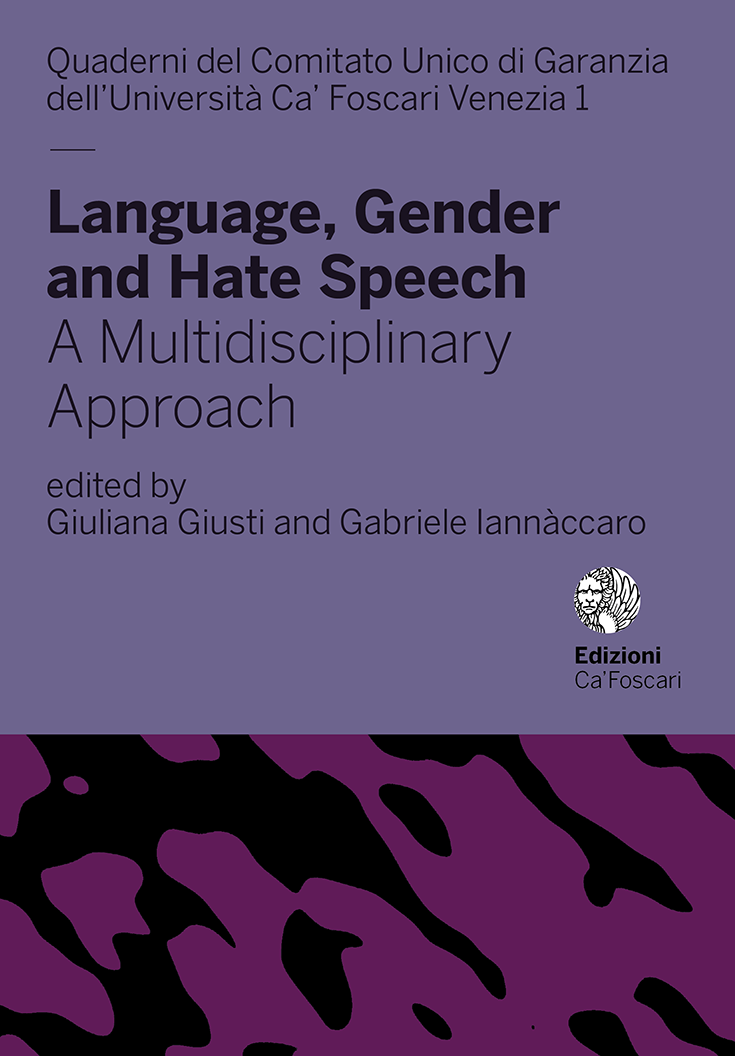
Language, Gender and Hate Speech
A Multidisciplinary Approach

abstract
Gender, language and hate speech: Are these concepts unrelated to each other, or is it possible to find a common research thread that allows us to understand them as two aspects of the same social phenomenon? This is the question to which the book aims to give an answer, through the support of experts and scholars in the areas of Linguistics, Education, Sociology, Legal and Political Studies. The volume collects some of the papers presented at the LIGHTS (Gender equality and hate words / Language gender and HaTe Speech) conference, held at Ca’ Foscari University of Venice on October 2018, which represented a significant moment of discussion and confrontation on the power of language for the maintenance or, hopefully, the deconstruction of social and political stereotypes.
-
Keywords keyboard_arrow_down
Woman • Council of Europe • Gender-Specific Swear Words • Stereotypes • EU Legislation • Gender equality • Media • Politics • Repetition • Politeness Formulas • Sexist Language • Spoken Communication • Algerian French • Italy • Gender Representation • Global Media Monitoring Project • LGBTQ+ • Italian Language and Linguistics • Innovativeness • Ciao • Homonationalism • Recipient • Jurisdiction • CDA • Feminization • Discrimination • Gender Perception • Women • Violence • Linguistic sexism • Authority • WhatsApp Communication • Corpus Linguistics • Human rights • Reduction • Gender Stereotypes • Gender-Inclusive Language • Interaction • Italian Sociolinguistics • Corpus linguistics • Gendered Hate Speech • Hate Crimes • Criminalization in Italy • Feminine Job Titles • Hate Speech • Hate speech • Internet Regulation • Italian Morphology • Female Voters • Gender • Topic modelling • Brexit • Conservativeness • Grammatical gender • Algerian press • Language emancipation • Nouns of occupations • Sexism • Inclusive language • Misogyny • CMC • Gender resolution • Text Analysis • Freedom of speech • VAWG • Political speech • Free Speech • Media language • Survey Methods • Feminisation • Gender Studies • Language and gender • Multimodal analysis
Table of contents
- search 718 view
- file_download 212 download
Highlight Chapter
- search 1016 view
- file_download 257 download
Part I • Corpus-Based and Experimental Studies
- search 759 view
- file_download 202 download
- search 385 view
- file_download 35 download
- search 348 view
- file_download 39 download
- search 244 view
- file_download 7 download
- search 330 view
- file_download 30 download
- search 313 view
- file_download 28 download
Part ΙΙ • Juridical Perspectives, Monitoring and Good Practices
- search 339 view
- file_download 35 download
- search 342 view
- file_download 26 download
- search 284 view
- file_download 15 download
- search 585 view
- file_download 90 download
- search 378 view
- file_download 59 download
- search 262 view
- file_download 11 download