- search 2094 views
- file_download 536 download
- keyboard_capslockmetadata
-
mark_email_readIscriviti alla newsletter
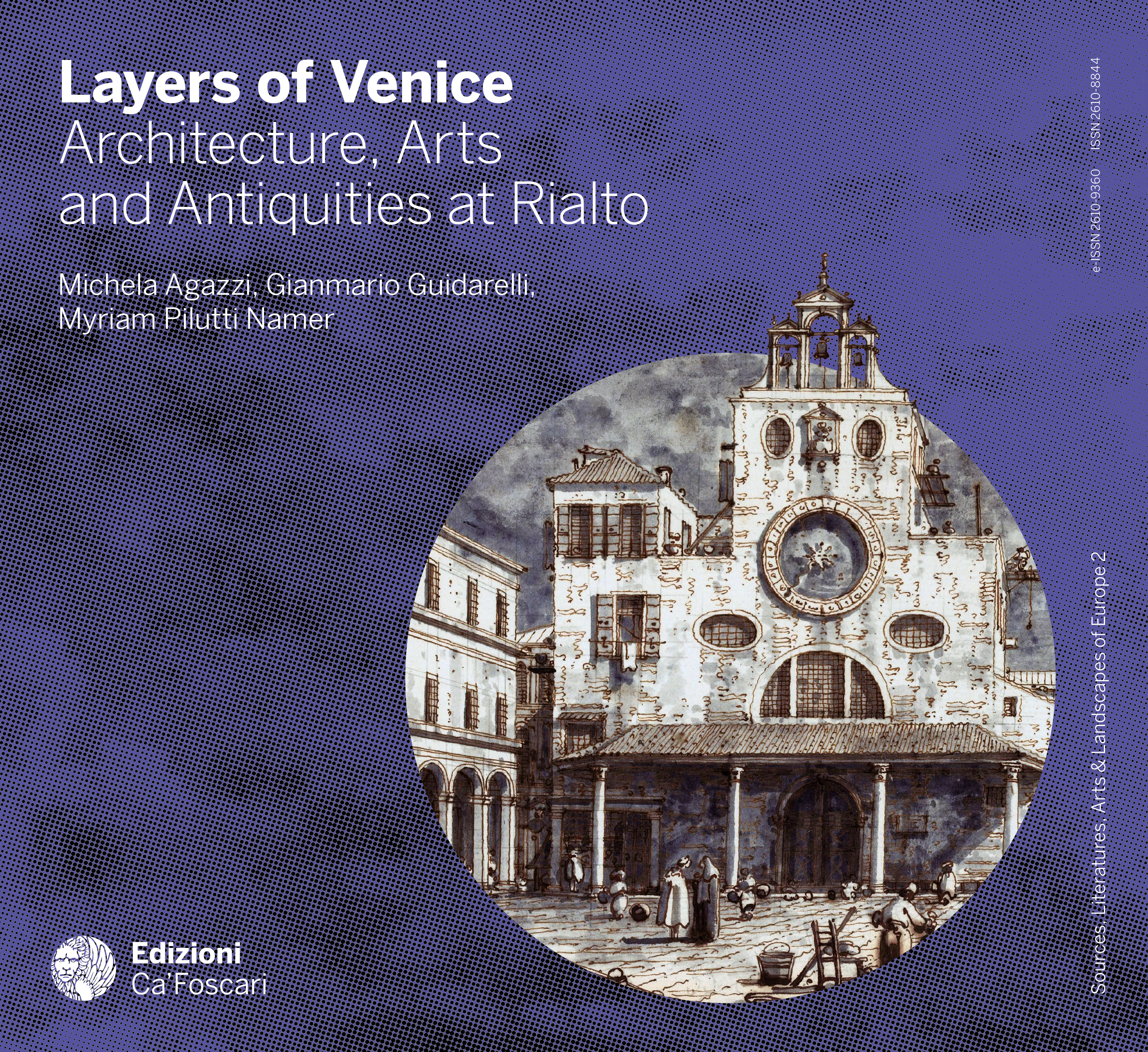
Layers of Venice
Architecture, Arts and Antiquities at Rialto
Michela Agazzi
Università Ca’ Foscari Venezia, Italia

Gianmario Guidarelli
Università degli Studi di Padova, Italia
abstract
The book offers a greater understanding of the multiple layers of meaning that have been superimposed in the course of the Medieval and Modern Ages in the Rialto area. The authors follow the Leitmotiv of the memorial component that each operation of architectural reuse has carried in the history of the church of San Giacomo di Rialto, a building which stands, emblematically, as a sort of architectural relic. Adopting this principle, the book offers an in-depth analysis of the spatial model, the reuse of individual architectural and decorative elements but also, on a larger scale, the different configurations of the urban context (the Rialto market) through the centuries, after repeated destruction, reconstruction and transformation. By adopting this multi-scale approach, the book reveals the key role played by the church in the narrative strategy adopted to perpetually renew the myth of Venice, taking on a conceptual and polysemantic dimension where each component (object, context, meaning, function, image) constitutes an element cultural memory, with each leaving a tangible trace of its own.
-
Keywords keyboard_arrow_down
Acqua alta • Venetian Renaissance Sculpture • Reused materials • Bridge of Rialto • Vigilio Rubini • Early modern trade • Basilica • Urban History • Ancient Roman Capitals • Venetian Trade Guilds • Alessandro Vittoria • Venetian early modern architecture • Rialto • Trading places • Medieval architecture • Marbles • High Middle Ages • Medieval town • Church of San Giacomo at Rialto • Banks • Early modern commercial institutions • Restoration • Andrea dall’Aquila • History of Venice • Venice • San Giacomo di Rialto • Venetian Architecture • Early Byzantine Capitals • Medieval • Byzantine • Greek cruciform • Romanesque • Lieu de mémoire • Venetian Republic • Concieri • Reuse of building materials • Stones • History of Architecture • Giustizia • Spolia
Table of contents
- search 206 view
- file_download 30 download
Section I. Rialto’s Area in Medieval and Modern Time
- search 262 view
- file_download 47 download
- search 210 view
- file_download 34 download
- search 207 view
- file_download 28 download
Section II. On the Horns of a Dilemma
- search 356 view
- file_download 46 download
- search 205 view
- file_download 29 download
- search 165 view
- file_download 20 download
- search 259 view
- file_download 38 download
- search 245 view
- file_download 33 download