Chapter 1. Reference
The term reference refers to the symbolic relationship between a linguistic expression and a concrete or abstract entity which is represented by the linguistic expression. We call referring expression the linguistic expression which denotes the abstract or concrete entity and discourse referent the entity referred to. For example, a cat called ‘Fufy’ represents the discourse referent. We can refer to this cat using several referring expressions, like the noun phrase ‘the cat’, the proper name ‘Fufy’, or both of them ‘Fufy the cat’. We can also refer to the cat using a pronoun which is contextually related to the cat, as shown in the example below, where the pronoun is highlighted in bold.
cat ix(dem) beautiful-int ix3 sleep all_day
‘That cat is very beautiful, but s/he sleeps all day.’
All these referring expressions relate to the same entity: the cat ‘Fufy’.
By focusing on noun phrases and pronouns, we can classify them with respect to their deictic or anaphoric uses. An expression is called deictic if it receives its reference from an extra-linguistic context. This is displayed in the sentence below.
Context: At the post office, someone asks for information indicating a letter.
wh
ix3 mail where
‘Where can I mail it (indicating the letter)?’
On the contrary, anaphoric expressions pick up a discourse referent from the preceding test or discourse. The example below shows a type of anaphoric expression in LIS, that in this case is a pronoun.
woman CL(G): ‘woman_move’ 3CL(V): ‘look_at’1. ix3 beautiful-int
‘A woman is walking, and then she suddenly turns to me, she is very beautiful.’
However, the distinction between deictic and anaphoric expressions is not always clear-cut, as shown by the sentence below uttered in the given context.
Context: After a teacher left the classroom, a student signs the following sentence.
ix3 homework 3CL(5): ‘give_a_lot’1 too_many
‘She gave us too much homework.’
No previous mention to the teacher was explicitly done before the use of the pronoun as a referring expression. Moreover, the pronoun is not properly deictic since the teacher was no longer present in the classroom at the time of the utterance.
1.1. Deixis
Deictic elements are expressions that directly refer to entities present in the context of conversation. Deictic elements can also be temporal (tomorrow) or locative (here), in which case they refer to the time and place of utterance. Consider as an example the sentence below.
ix1+2 meet tomorrow
‘See you tomorrow.’
The correct interpretation of this sentence is not possible because we lack the contextual information about where and when it was signed and about who was present. Therefore, we are not able to interpret who corresponds to the indication ix1+2, and we are not able to understand if the sign tomorrow refers to our future, or to a future in the past.
Leaving beside the spatio-temporal information, deictic expressions which refer to physical entities generally consist of an index handshape directed toward these entities. Such a pointing is realised in a specific signing space location previously established and associated to the discourse referent, as shown in the repeated example below.
Context: At the post office, someone asks for information indicating a letter.
wh
ix3 mail where
‘Where can I mail it (indicating the letter)?’
The pointing sign may show some variation due to phonological processes, like assimilation (PHONOLOGY 3.1.1). In this case, the pointing sign may assimilate a parameter of neighbouring signs. This is exemplified in the example below, where the deictic pointing sign referring to a contextual object and the sign pointing to the interlocutor are realised with the same orientation (palm up) displayed by the nearby verb want. Indeed, such a position is more comfortable for the wrist, which does not need to turn twice to produce the pronominal signs.
ix3 want ix2
‘Do you want it?’
1.1.1. Pointing
In LIS, pointing is expressed with a manual sign directed toward an area in the signing space. A pointing sign may occur alone or together with another sign. In the former case, it fulfils a pronominal function (LEXICON 3.7), as shown in the example below, repeated for reason of clarity.
woman CL(G): ‘woman_move’ 3CL(V): ‘look_at’1. ix3 beautiful-int
‘A woman is walking, and then she suddenly turns to me, she is very beautiful.’
In the second case, the pointing accompanies another sign, possibly functioning as a determiner (LEXICON 3.6) (SYNTAX 4.1), as shown in the example below.
popea ixa america southb aflyb
‘The Pope flew to South America.’
It has been observed that the direction of eye gaze correlates with the demonstrative function. In particular, if the eye gaze is directed towards a referent, the signer indicates that the referent is physically present in the extra-linguistic context. However, the use of this marker is optional, as displayed in the example below, where no eye gaze occurs.
wh
A: ix2 clothes buy what
B: ix1 buy pea shirt ixa
‘What type of dress did you buy?’ ‘I bought this very shirt.’
1.1.2. Social deixis
In a discourse the social characteristics of the participants can be referred to by specific uses of deixis, which are called social deixis.
The possibility to encode social distinctions in LIS seems to be subject to some variation. According to some LIS signers, nothing changes in the signing production if a participant has a high social status. Other signers report that social distinctions can be conveyed by handshape change. In particular, honorific pronouns (LEXICON 3.7.2.6) can be marked by using the unspread 5 handshape rather than the G handshape, as displayed in the picture below.

Figure: Unspread 5 handshape used as honorific form
Below, we provide an example containing the honorific form ix(unspread 5)2.
Context: In a business company, the boss of the company enters the room where an employee is sitting. The employee stands up and signs the following sentence.
welcome sit ix(loc)a be_able ix(unspread 5)2
‘Please, come, you can have a seat there.’
Another type of strategy which may signal social distinctions is represented by specific uses of the signing space. Contrast between the upper and lower part of the frontal plane may be used to convey asymmetrical relationships, as for parent-child or boss-workers relationships (PRAGMATICS 8.1.2). To illustrate, we show in the video below the relation between a grandfather (localised higher in space) and his grandson (localised lower in space).
pietro ixa grandfather ix[up] ix[down] grandson ix3a
‘Pietro is the grandfather’s grandson.’
1.1.3. Lack of deixis
Lack of deictic expressions might convey generic reference or reference to a class of entities; indeed, a bare noun in LIS may express genericity, as exemplified by the sign fish and egg in the sentence below.
fish egg give_birth++distr take_care++distr
‘Fishes make eggs and take care of them.’
1.2. Definiteness
Definite noun phrases are nominal arguments that denote discourse referents with the property of being univocally identifiable, as shown in (a) or the property of being familiar to both the signer and the interlocutor. Entities are familiar when: i) they are co-present in the context where the utterance is pronounced, as shown in (b), ii) are culturally shared in the common ground of the signer and the addressee, as shown in (c), or iii) had been previously mentioned in the discourse, as shown in (d).
tl
a. moon SASS(L): ‘round_big’
-
‘The moon is completely full.’
-
rel
-
b.keya ixa table CL(closed G): ‘put_on_a’ ixa atake1
-
‘I took the key that was on the table.’
top
c. president ixa person++b CL(5): ‘all’b bhatea
-
‘As for the President, the people hate him.’
d. street man persona ixa stroll. suddenly CL(5): ‘cloud_over’ rain. man ixa take umbrella
-
‘A man was walking on the street, when suddenly it clouded over and began to rain a lot. The man took an umbrella.’
1.2.1. Manual marking
Definiteness can be indicated by pointing signs. In LIS, pointing signs with the function of articles or demonstratives generally occur in post nominal position, giving the definite reference to the nouns (SYNTAX 4.1).
An example of pointing sign with the function of a definite article is displayed below.
dog ix play continue_va_va
‘The dog kept on playing.’
An example of pointing sign with the function of a demonstrative is shown in the discourse stretch below.
top
card ix(dem) ix1 need ix1
‘This card, I need it.’
1.2.2. Non-manual marking
In LIS, definite determiners, like articles and demonstratives, are both marked by means of non-manuals. The more common are raised eyebrows, chin up, contracted cheeks, and mouth slightly open (SYNTAX 4.1.1.3) (SYNTAX 4.1.2.3).
Moreover, the co-articulation of a sign marked with squint eyes might denote a referent that is known and familiar to both the signer and the addressee, although not necessarily salient for the addressee. In this case, squint eyes may function as a cue in order to stimulate the addressee to retrieve an entity already present in his/her mental storage, but less salient. An example of a previously mentioned topic reintroduced in the discourse and marked by squint eyes (sq) is presented below.
sq
housea ix(dem)a gianni agency buy done
‘As for that house, Gianni bought it at the estate agency.’
Another common non-manual marker which accompanies referents that are shared between the signer and the interlocutor is raised eyebrows (re), generally marking presupposed information. This is shown in the example below.
re
testa lisa ixa giannib barrivea late. testa neg_o
‘As for the LIS test, Gianni arrived late and did not take the test.’ (recreated from Brunelli, 2011: 216)
1.3. Indefiniteness
Indefinite noun phrases are nominal arguments which refer to those discourse referents that are unknown to the interlocutor. They fulfil the function of introducing new entities in the conversation. This is exemplified below.
today morning officea poss1 man one(indef)b bcomea
-
‘This morning a man came to my office.’
Indefinite noun phrases can refer to non-unique discourse referents, for example to elements which display their properties with a class of other elements. For this reason, these elements are not uniquely identifiable, as displayed in the example below.
night star CL(5): ‘shine’. beautiful-int
-
‘Tonight, the stars are shining and it’s very beautiful.’
1.3.1. Manual marking
In LIS, indefiniteness can be manually conveyed by the indefinite article one realised with the G handshape or with the S handshape. These elements generally occur in prenominal position, giving an indefinite value to the noun, but their realisation is not mandatory (LEXICON 3.6.2) (SYNTAX 4.1). The articulation of the indefinite article is realised in a steady position in an unmarked signed space or, alternatively, it may be accompanied by a tremoring motion. Such articulation relates to the degree of identifiability of the introduced constituent: the more unidentifiable it is, the broader the tremoring motion displayed. An example of indefinite article is presented below.
today one(indef)a skiera ix1 seea CL(curved open V): ‘zig_zag_ski’a
‘Today, I saw a skier skiing with a zig-zag pattern.’
Indefiniteness may also be conveyed by the sign someone, as shown below.
ix1 someone meet
‘I met someone.’
1.3.2. Non-manual marking
In LIS, a preference for the omission of the indefinite article has been detected in younger signers. Instead of the manual sign one, young signers are used to indicate the indefiniteness of a noun phrase by means of non-manual markings. The most common non-manuals are backward tilted head and mouth corners down, as shown in the example repeated below.
indef
today skier ix1 see CL(curved open V): ‘zig_zag_ski’
‘Today, I saw a skier skiing with a zig-zag pattern.’
1.4. Specificity
Specificity refers to a sub-classification of indefinite noun phrases. Specific indefinite noun phrases indicate discourse referents that the signer knows but the addressee does not, as shown in (a). On the contrary, non-specific indefinites are used when neither the signer nor the addressee knows the discourse referent, as shown in (b).
a. booka ix1 reada want ix1. libraryb ix1 1gob finda done atake1
‘I want to read a book. I went to the library, I found it, and I took it.’
-
b.today booka ix1 reada feel_like ix1. ixa booka ix(dem)a interesting must
-
‘Today I want to read a book. It must be an interesting one.’
In a nutshell, specificity correlates to the accessibility of the referent from the point of view of the signer.
1.4.1. Manual marking
In LIS, the lexical sign hearing is also used in context where the identity of the discourse referent is neither known nor close to the signer, as shown in the example below.
museum enter free_of_charge be_able hearing 3report1
‘Someone told me that you can get into the museum for free.’
In LIS, some manual signs seem to accompany and mark specificity by using different spatial locations. A specific interpretation arises, for example, when signs are realised in the lower frontal plane of the signing space.
frienda some[down]a hide
‘Some friends were hiding.’
On the contrary, when non-anchored common nouns or plain verbs refer to non-specific discourse referents, they may be realised in the upper frontal plane. The example below shows a non-specific reading: neither the signer nor the addressee know the identity of the liars.
palm_up ix[up]a lie someone[up]a person++[up]a friendb poss1 adenounceb
‘Some liars have denounced a friend of mine.’
1.4.2. Non-manual marking
In LIS, some non-manuals can also contribute in distinguishing specificity from non-specificity. In particular, raised eyebrows (re), wide-open eyes (we), and relaxed mouth-corners together with a backward head tilt (ht-b) may trigger a specific interpretation, namely the signer is talking about a discourse referent that she bears in mind.
ht-b
we
re
persona ixa friendb bseizea
‘A person (I know who) kidnapped a friend of mine.’
As for non-specificity, the facial expressions accompanying non-specific reading corresponds to those used for indicating indefiniteness, basically they are a backward tilted head (ht-b) and mouth-corners down (md).
md
ht-b
someonea ixb friendb ixb carb possb bseizea
‘Someone (I don’t know who) stole the car of a friend of mine.’
1.5. Impersonal reference
By impersonal reference, we intend the reference to individuals whose identity is not clear. When impersonal constructions are used, the degree of reference in the discourse is very low.
In LIS, impersonal reference can be marked by several strategies, both manual and non-manual. The manual signs triggering a low referential interpretation are the signs someone and person, both functioning as indefinite pronouns. These signs are found with special non-manuals highlighting that the signer does not know the identity of the referent: they combine raised eyebrows (re), chin slightly raised (cu), and mouth-corners pulled downward (md). To convey an agent-backgrounding reading, these non-manuals are obligatory with the sign person (a) and optional with the sign someone (b).
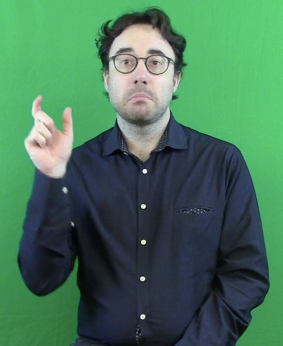
re
md
cu
a. person
‘Someone’

md
cu
b. someone
‘Someone’
The examples below show how the signs person (a) and someone (b) convey an impersonal reading.
re
md
cu
a. person house enter
‘Someone entered my house.’ (recreated from Mantovan & Geraci, 2018: 233)
re
md
cu
b. someone house enter
‘Someone entered my house.’ (recreated from Mantovan & Geraci, 2018: 233)
Another strategy that can be used to convey impersonality is null subject. In the example below, subject omission is compatible with a singular or plural referent. If no particular facial expressions are produced, the null subject is ambiguous between the referential and the impersonal reading. However, if the impersonal non-manuals described above spread over the verb or the entire clause, the impersonal reading becomes more prominent.
house enter
‘Someone entered my house.’ (recreated from Mantovan & Geraci, 2018: 233)
The null subject is the preferred impersonal strategy when generalising or corporate readings are involved. The example below is characterised by a generalised interpretation because the subject of the sentence does not refer to some particular Spanish individual, rather to a collectivity (i.e. Spanish people).
be_common ix(loc) spain eat late
‘In Spain, people are used to eat late.’
The corporate reading emerges when a designated group of people is selected. In the example below, the subject does not refer to some particular individual, rather to the government or another institutional group.
tax raise
‘The government/they raised the taxes.’ (recreated from Mantovan & Geraci, 2018: 251)
The difference between referential and impersonal readings can be marked by the use of space. Referential readings emerge through the selection of specific points of the neutral space, whereas impersonality usually involves undefined and unmarked locations. In the case of plain verbs (LEXICON 3.2.1), impersonality does not affect the form of the verbal sign. In the example below, the verb smoke is produced in its citation form and the subject is omitted.
house inside smoke forbidden
‘It is not allowed to smoke in the house.’ (recreated from Bertone, 2011: 186)
In the case of agreeing verbs (LEXICON 3.2.2), impersonality is conveyed through the multiple repetitions of the verb in different locations of an undefined central area of the signing space. In the example below, the agreeing verb report is repeated with both hands in different unmarked locations suggesting that there are several different agents and patients whose identity is not clear.
report++ ix woman ix pregnant
‘It’s rumoured that the woman is pregnant.’
With backward agreeing verbs, impersonality is also conveyed through reduplication in different unmarked location. In the example below, the backward agreeing verb copy is repeated by alternating the two hands.
re
test pass palm_up obligation copy++
‘To pass the test, you have to copy.’
Finally, note that regular personal pronouns (LEXICON 3.7) cannot be used to convey an impersonal interpretation. Pointing pronouns, directed toward specific locations in space, refer to some contextually salient individual. However, an exception can be found in conditional clauses. Under a conditional-context, both the first- and second-person pronouns can receive an impersonal interpretation. This special behaviour of pointing pronouns can be observed in the two examples below: both ix1 (a) and ix2 (b) are associated with an impersonal value.
cond
a. ix1 cara seizea automatic ix1 jail inside
‘If somebody steals a car, then he goes to jail.’
cond
b. ix2 person++a offenda exclude2 second
‘If somebody is offensive, s/he is immediately excluded.’
Information on Data and Consultants
The descriptions in these sections are based partially on the references below and on the elicitation of new data. The linguistic data illustrated as images and video clips have been checked through acceptability judgments and have been reproduced by Deaf native-signing consultants.
Authorship Information
Chiara Calderone [1.1] [1.2] [1.3] [1.4]
Lara Mantovan [1.5]
References
Amorini, Giuseppe & Luigi Lerose. 2012. Studi linguistici in Lingua dei Segni Italiana (LIS) – Analisi fonologica e le funzioni deittiche ed avverbiali, e aspetti metaforici in parametri formazionali. Klagenfurt: Alpen-Adria-Universität, PhD dissertation. (300-325) [1.1]
Bertone, Carmela. 2007. La Struttura del Sintagma Determinante nella LIS. Venice: Università Ca' Foscari, PhD dissertation. (148-163) [1.1] (143-148) [1.4]
Bertone, Carmela. 2011. Fondamenti di grammatica della lingua dei segni italiana. Milano: Franco Angeli. (40-45) [1.1]; (122-131) [1.2], [1.3]; (122) [1.4]; (185-188) [1.5]
Brunelli, Michele. 2011. Antisymmetry and Sign Languages. A Comparison between NGT and LIS. Utrecht: LOT. (214-219) [1.2.2]
Mantovan, Lara. 2017. Nominal modification in Italian Sign Language (LIS). Berlin: De Gruyter Mouton. (154-184) [1.2], [1.3]
Mantovan, Lara & Carlo Geraci. 2018. R-impersonal interpretation in Italian Sign Language (LIS). In G. Barberà & P. Cabredo Hofherr (eds.), Reference Impersonals in Sign Languages (special issue of Sign Language & Linguistics) 21(2). 232-257. [1.5]
Pizzuto, Elena. 2007. Deixis, anaphora and person reference in signed languages. In: E. Pizzuto, P. Pietrandrea & R. Simone (eds.), Verbal and Signed Languages: comparing structures, constructs and methodologies, 275-308. Berlin: Mouton De Gruyter. [1.1]