Chapter 5. The structure of adjectival phrase
An adjectival phrase functions as a modifier of the noun (SYNTAX 4.5). The head of this syntactic construction is an adjective (LEXICON 3.4). In this chapter, we show that the adjectival head can be modified both manually and non-manually (SYNTAX 5.1), it can select arguments of different types (SYNTAX 5.2), and it can be modified by adjuncts (SYNTAX 5.3).
5.1. Intensifiers and other modifiers
Adjectives can be divided into two categories: gradable and ungradable. The former can express different degrees of a given quality. For instance, the sign cold in LIS is gradable because it can be used to describe different degrees of temperature: very cold, pretty cold, a bit cold, etc. Adjectives of this kind can occur in comparative or superlative constructions. On the contrary, ungradable adjectives cannot express different degrees of a given quality. For instance, the sign dead cannot vary in intensity or degree. Adjectives of this kind cannot occur in comparative or superlative constructions.
In this section, we see which strategies can be used to modify gradable adjectives in LIS.
5.1.1 Manual modifiers
In LIS, gradable adjectives can be modified by adding a manual sign that directly indicates the intended degree. The preferred order is adjective followed by its manual modifier. In the adjectival phrase shown below, the adjective beautiful is followed by its modifier quite.
painting beautiful quite
‘A quite beautiful painting’
The modifier quite is typically used to indicate a moderate degree which is perceived as satisfactory. This sign is accompanied by the following non-manuals: furrowed eyebrows, lips protrusion, and sideward head tilt.
Other signs that can combine with adjectives, specifying their intensity or degree, are listed below. Like quite, these modifiers preferably follow the adjective. For the sake of clarity, the order of presentation follows a hypothetical scale from more to less.
Table: List of modifiers that can occur with gradable adjectives
|
extremely |
strong |
very |
|
quite |
so_so |
a_bit |


Note that the degree of intensification can be further specified by the co-occurring non-manuals.
5.1.2. Modifications of manual signs and non-manual modifiers
The degree or intensity of the adjective can be encoded through the simultaneous modification of the sign for the adjective. This can be done by modifying its manual articulation and/or by adding specific non-manual markers simultaneously occurring with it. In LIS, intensive and approximative modifications can be observed. In what follows, we present the manual and non-manual strategies conveying these meanings.
The intensive modification is used to express a high degree on the semantic scale of the adjective. The form of the adjectival sign is usually modified in the movement component: i) it can be slower, and slightly hold at the beginning of the articulation, and ii) it can be larger or restricted. If the adjective is a one-handed sign in its citation form, the non-dominant hand may become active to copy the dominant hand. Such phonological addition is another strategy to reflect intensive meaning. The non-manuals that are usually adopted to convey intensification are furrowed eyebrows (fe) and wide-open eyes (we). To illustrate these manual and non-manual strategies, compare the citation form of the adjective strong (a) with its intensified version (b).
a. strong
we
fe
b. strong
‘Very strong’
To express a high degree of intensification, the beginning of the sign might be characterized by a long tense hold and closed eyes (ce), as shown below.
ce we
good
‘Very good’
A special case that needs to be mentioned is the sign beautiful. Apparently, this is the only adjective in LIS whose form can be modified by a manual bound morpheme to convey intensive meaning. For more details, see MORPHOLOGY 2.1.1.
On the other hand, the approximative modification is used to express a low degree on the semantic scale of the adjective. It usually affects the movement component of the sign, making it look restricted and more relaxed. If the adjective is a two-handed sign in its citation form, the non-dominant hand may undergo weak hand drop (PHONOLOGY 3.1.4). Such phonological reduction is another strategy to reflect approximative meaning. The non-manuals that are usually adopted to convey approximation are squint eyes (sq) and sometimes raised eyebrows (re). To illustrate these manual and non-manual strategies, compare the citation form of the adjective mischievous (a) with its approximative version (b).
a. mischievous
sq
re
b. mischievous
‘Sort of mischievous’
5.1.3. Iteration and stacking
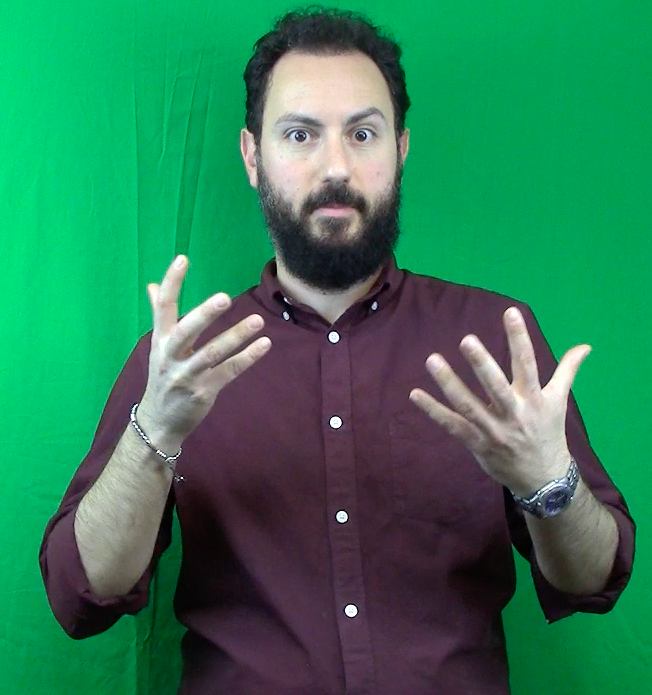
Adjectives within adjectival phrases can be modified not only by intensive or approximative modifiers (SYNTAX 5.1.2), but also by qualitative modifiers such as those specifying the shade of colour adjectives. Again, manual and/or non-manual strategies can be used. For example, different shades of red can be conveyed. A bright shade can be expressed by articulating the sign red with raised eyebrows and wide-open eyes (a), or by adding a manual modifier such as bright, marked by the same non-manuals (b).

re
we
a. red
‘Bright red’

re
we
b. red bright
‘Bright red’
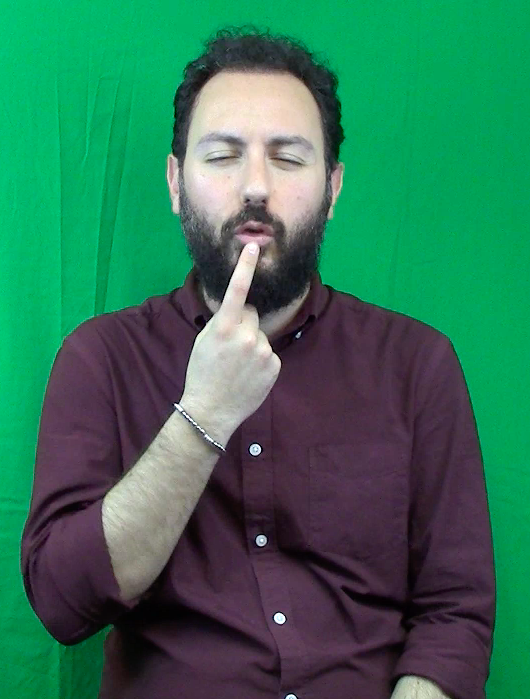
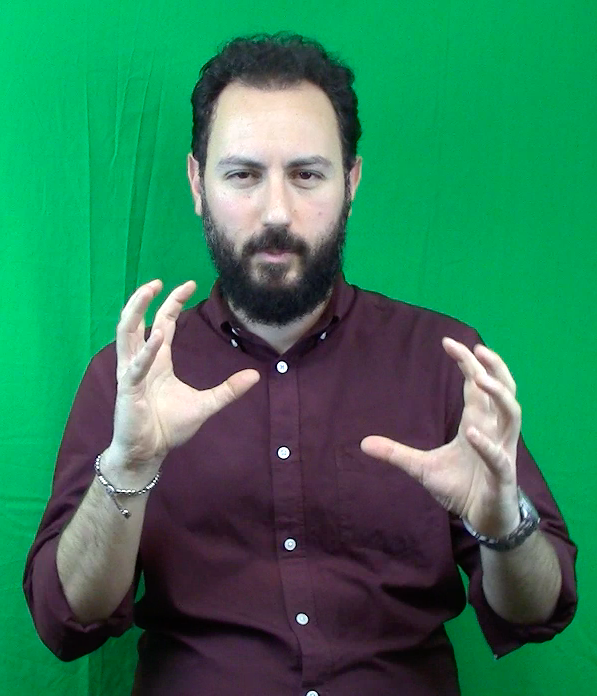
A dark shade of red can be expressed by articulating the sign red with furrowed eyebrows and squint eyes (a), or by adding a manual modifier such as dark, marked by the same non-manuals (b).
sq
fe
a. red
‘Dark red’
sq
fe
b. red dark
‘Dark red’
Other non-manual and manual modifiers that can combine with colour adjectives are those conveying attenuative meaning. For more details, see MORPHOLOGY 2.1.1.3 and MORPHOLOGY 2.1.2.2.
It is worth noting that, for each kind of modification, non-manual and manual modifiers are not in complementary distribution. Indeed, they can be combined together to reinforce the intended meaning (brightness, darkness, or attenuation).
5.1.4. Degree comparatives
Since gradable adjectives can vary in degree, they can enter degree comparative constructions (SYNTAX 3.6). Before going into details, it is important to make a distinction between two classes of gradable adjectives. Some of them are SASS (MORPHOLOGY 5.2) and represent the degree of the property iconically: for example, the adjective tall maps height onto the signing space. The higher the extended arm, the higher the referred entity.
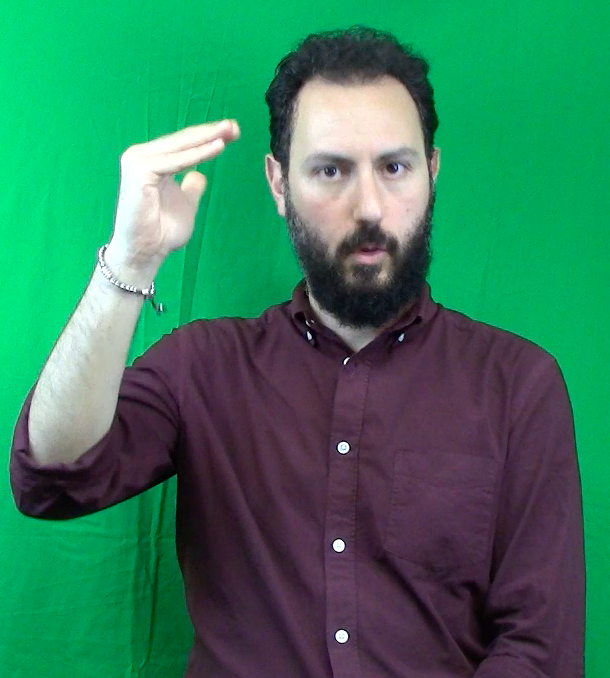
tall
Other adjectives cannot encode this information iconically. For instance, the articulation of the adjective intelligent cannot map the degree of smartness onto the signing space.
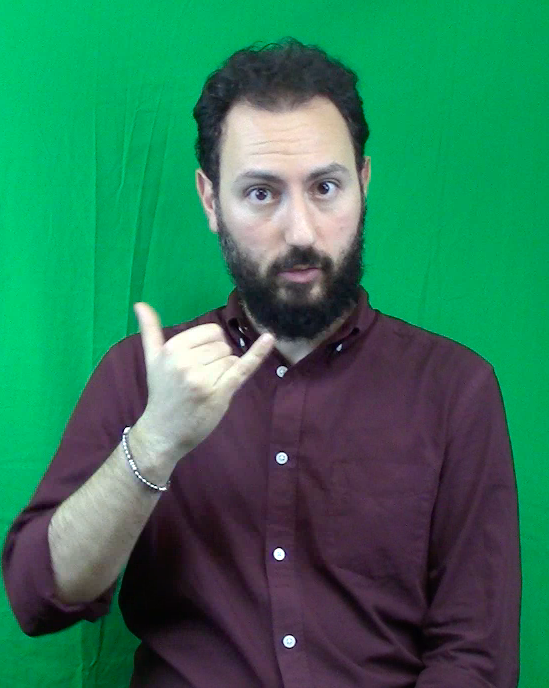
intelligent
The distinction between these two adjectival classes is relevant to the realisation of degree comparatives. Gradable adjectives with iconic mapping (like tall) allow two strategies: an analytic form that consists in the articulation of the lexical comparative marker more (a) or a synthetic form in which the adjective incorporates a morpheme expressing the degree iconically (here glossed as iconic_more) (b).

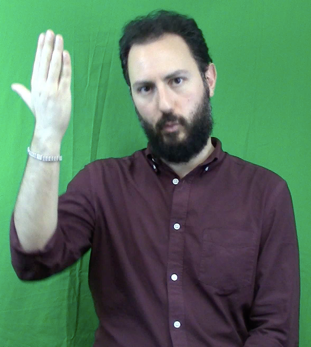
a. more
(based on Aristodemo & Geraci, 2018: 691)

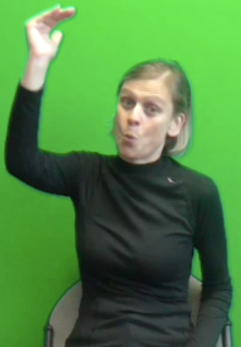
b. tall.iconic_more
‘Taller’ (based on Aristodemo & Geraci, 2018: 691)
For more details on comparative constructions, see SYNTAX 3.6.
Note that the comparative marker more included in the analytic construction may occur with some variant forms. As for the synthetic construction, iconic_more maps degree onto the signing space: a set of ordered points in space (the starting and end point of the sign) corresponds to a set of ordered degrees. The more distant the points, the more distant the degrees. To illustrate, we show below how the articulation of tall.iconic_more iconically changes on the basis of the difference compared: supposing that a man is 1 metre 80, the woman in (a) is 1 metre 82 and the woman in (b) is 1 metre 99.
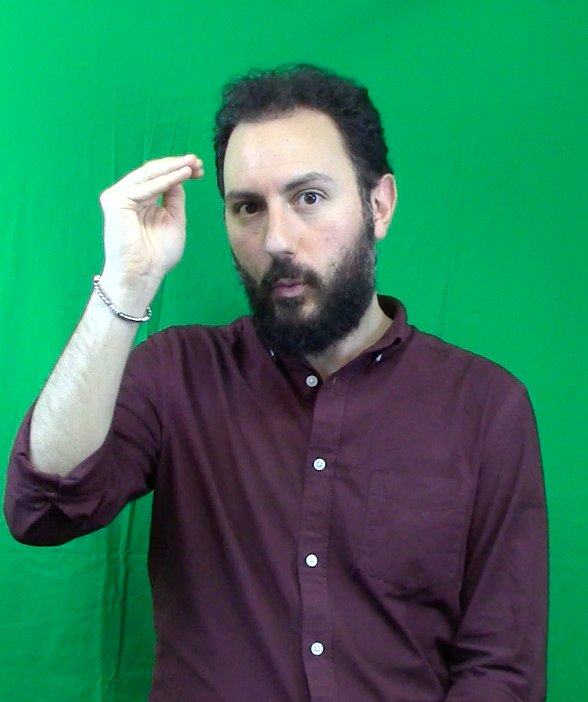
a. a_bit.tall.iconic_more
‘A bit taller than’
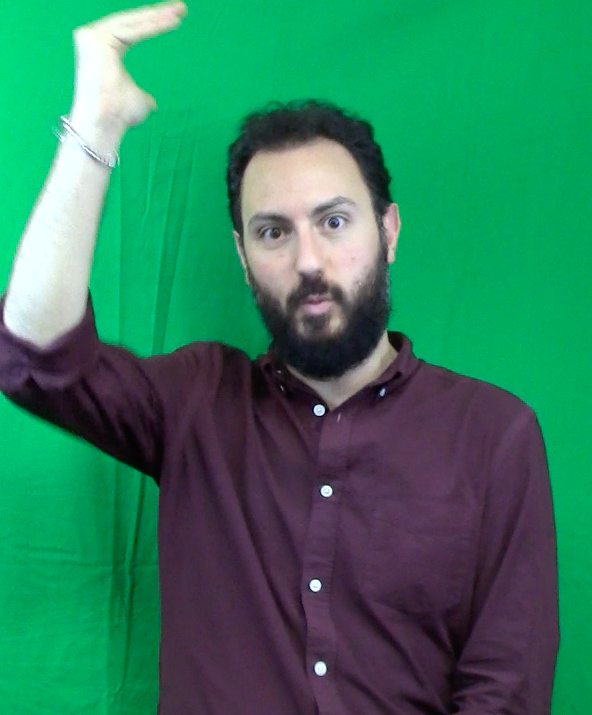
b. a_lot.tall.iconic_more
‘A lot taller than’
Because of their nature, gradable adjectives without iconic mapping (like intelligent) cannot resort to the synthetic form to express degree comparatives. The only possibility is to combine the adjective with the lexical marker more.
5.1.5. Superlatives
Gradable adjectives can also be modified to encode superlatives. These express the highest degree on the semantic scale associated with the adjective.
Two strategies that can be used to convey superlatives in LIS consist in the addition of the sign first (a) or most (b) after the adjective. Both signs are articulated with upward path movement.
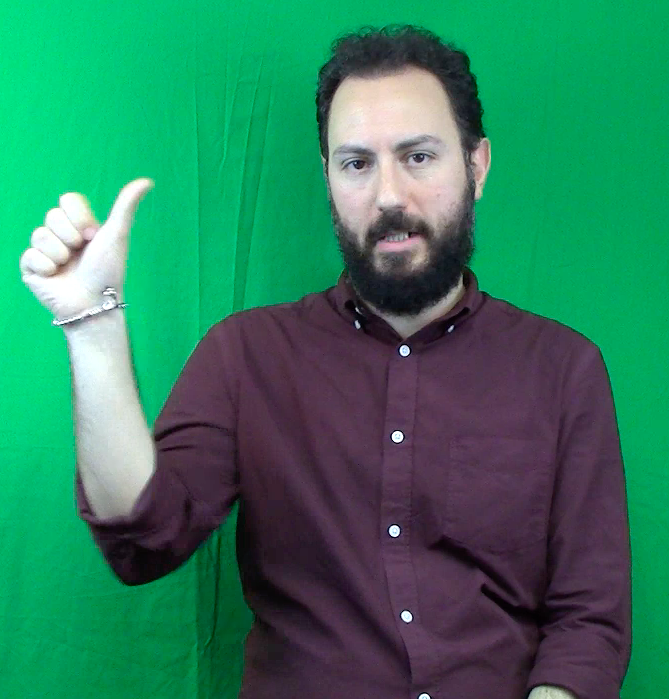
a. first
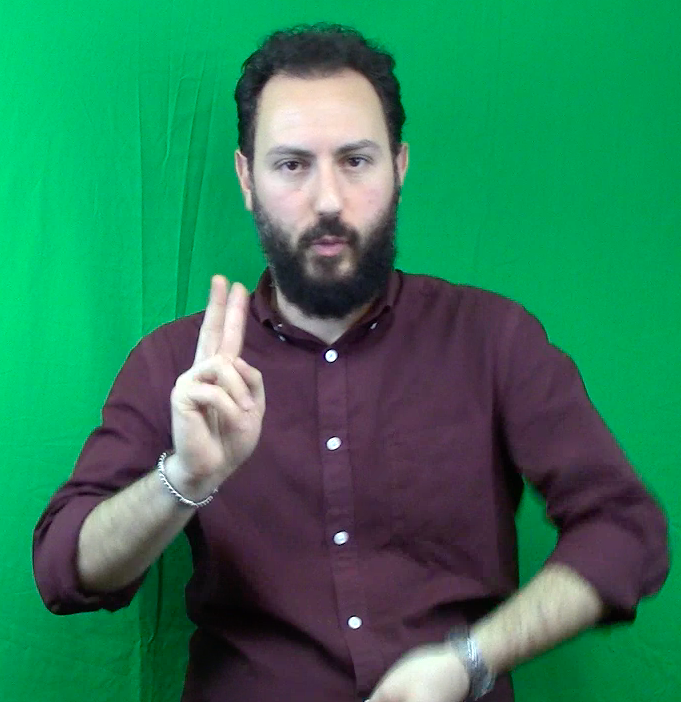
b. most
Superlatives are often used to compare one entity to a group of other entities. For example, if one kid is the smartest in his class, the following two superlative constructions can be used.

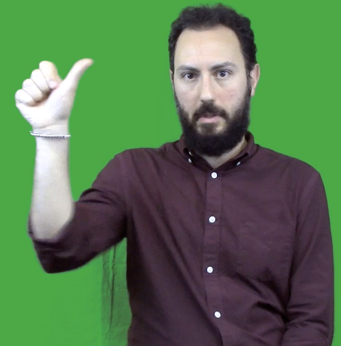
a. intelligent first
‘The smartest’

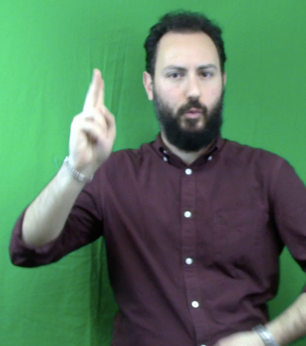
b. intelligent most
‘The smartest’
In these cases, the signs first and most do not provide different semantic contributions.
5.2. Arguments
Some adjectives can have arguments, i.e. constituents they select. Both the adjectival head and its argument are included in the adjectival phrase.
In LIS, the argument taken by the adjective can be of different types (SYNTAX 2.1.2). The adjectives in the examples below take a noun phrase as argument: envious selects a pronoun (a), while full selects a noun (b).

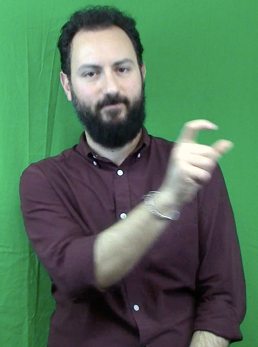
a. envious ix3_person
‘Envious of her/him’

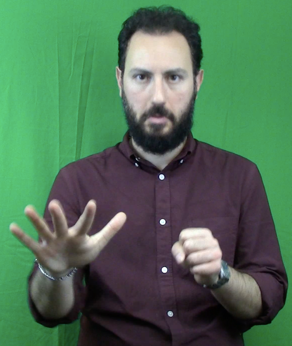
b. money full
‘Full of money’
If the argument is a pronoun, as in (a) above, signers allow both orders (i.e. adjective + argument and argument + adjective). If the argument is a full noun, as in (b) above, the preferred order is argument + adjective.
Below, we present examples containing the adjectives proud (a) and curious (b). Both of them take clausal arguments.
a. kida ixa high_school_diploma promote father proud
‘The father is proud that his son has obtained the high school diploma.’
b. politician earn how_many persona ixa curious
‘That person is curious how much politicians earn.’
Although other orderings are possible, LIS signers tend to produce clausal arguments before the related adjective, as shown above.
5.3. Adjuncts
Some adjectives can be modified by adjuncts, i.e. constituents they do not select. The relation between adjective and adjunct typically involves causality or comparison.
In a causal relation, the adjunct provides a justification or a reason. In the example below, the clausal adjunct explains why the subject of the sentence is happy.
1meet2 happy
‘I am happy to see you.’
Note that the preferred order is clausal adjunct + adjective, as shown in the example above.
In comparisons, the adjunct usually follows the adjective and presents a similarity or dissimilarity between two or more entities. In the two examples below, the adjuncts identical tomato (a) and as_if carrot (b) modify colour adjectives.
a. face red identical tomato
‘(His) face is as red as tomato.’
b. hair colour orange as_if carrot
‘(His) hair is as orange as carrot.’
Information on Data and Consultants
The descriptions in this chapter are based partially on the references below and on the elicitation of new data. The linguistic data illustrated as images and video clips have been checked through acceptability judgments and have been reproduced by Deaf native-signing consultants involved in the SIGN-HUB project.
Authorship Information
Lara Mantovan
References
Aristodemo, Valentina & Carlo Geraci. 2017. Visible degrees in Italian Sign Language. Natural Language and Linguistic Theory 36(3). 685-699. [5.1.4]
Bertone, Carmela. 2007. La Struttura del Sintagma Determinante nella LIS. Venezia: Università Ca’ Foscari, PhD dissertation.
Bertone, Carmela. 2009. The Syntax of Noun Modification in LIS. Working Papers in Linguistics 19. 7-28.
Bertone, Carmela. 2011. Fondamenti di grammatica della LIS. Milano: Franco Angeli. (28-31) [5.1.3]