Chapter 3. Phonological processes
In human languages, the realisation of phonemes can be influenced by several factors, thus resulting in different output forms. Specifically, in certain phonological environments, a phoneme (or a set of phonemes) can be subject to manipulations, which are due to the application of so-called phonological processes. These can be defined as rules or constraints that determine how phonemes are to be produced in a given phonological environment.
Generally speaking, in sign languages the implementation of phonological processes might be motivated by the need to maximize either ease of articulation or ease of perception. In other cases, they might be used to adapt loan signs (LEXICON 2) to the phonemic inventory of the target language. They can also result from the application of morphological processes, such as compounding, or syntactic reasons. Phonological processes can apply to different domains: phoneme, syllable, prosodic word, etc. Their occurrence can be obligatory or optional: that is, some of them are always applied by signers, while others might depend on other factors, such as the formality-informality of the setting.
This chapter discusses the main phonological processes occurring in LIS, providing illustrative examples. For the sake of clarity, the different processes are grouped according to the phonological component affected by the process itself. Specifically, we describe processes affecting the phonemic level (PHONOLOGY 3.1), syllable (PHONOLOGY 3.2), prosodic word (PHONOLOGY 3.3) and higher prosodic units (PHONOLOGY 3.4). Note that this chapter mainly concentrates on those phonological processes occurring in the synchronic grammar, shared by LIS signers at present.
3.1. Processes affecting the phonemic level
This section presents those phonological processes affecting the shape of the smallest phonological unit, the phoneme. In LIS, we find five classes of phonemes (also called phonological parameters): handshape, orientation, location, movement, and non-manual markers (PHONOLOGY 1). Each of them can be affected by phonological processes. Here we illustrate assimilation, coalescence, movement reduction and extension, weak hand drop, handshape drop, nativisation, and metathesis.
3.1.1. Assimilation
Assimilation is a process by which a sign takes on (i.e. assimilates) one or more features of a phoneme belonging to a neighbouring sign. This phonological process can affect all phonological parameters of a sign. The most typical case is handshape assimilation, which occurs when the handshape of a sign becomes more similar to the handshape of a sign close to it. Below, we can observe an example of assimilation.
year^one foggia ix1 commute
‘I commuted to Foggia for one year.’
The first-person pronoun (ix1) is not produced with its canonical handshape (extended index finger), but with the handshape of the following sign (flat open 4 in the sign commute). In this example, assimilation operates backwards because the handshape of commute influences the handshape of the preceding sign. This process is known as regressive (or anticipatory) assimilation.
Assimilation can also occur in the opposite direction. When the change operates forwards, it is called progressive (or perseverative) assimilation. It is exemplified below.
work continue so_far
‘I have kept working.’
In the example above, the symmetrical two-handed sign so_far is not produced with its canonical handshape (extended index finger), but with the handshape of the preceding sign (extended 5 in the sign continue).
Another possibility is the so-called bidirectional assimilation, a combination of progressive and regressive assimilation. In this case, both the preceding and the following forms exert an influence on the form undergoing assimilation.
future ix1 commute be_fed_up
‘In the future, I'll be fed up to commute.’
In this example, the first-person pronoun (ix1) is not produced with its canonical handshape (extended index finger), but with the handshape of both the preceding and following signs (future and commute are articulated with flat open 4).
It is important to notice that assimilation can be total or partial. In total assimilation, all features of the neighbouring form are copied. By contrast, in partial assimilation, only some features are copied. To see the difference between these two types of assimilation, we observe different realisations of intelligent. This is a compound sign formed by the sign head and a Y-handshape classifier conveying the concept of a large amount. In its original form, the first part of the compound is articulated with extended index finger, as shown below.


intelligent (citation form) (recreated from Battaglia, 2011: 198)
In a variant of intelligent, the first part of the compound undergoes partial assimilation. It copies only one particular feature of the handshape of the second part, namely extended thumb. Therefore, the resulting handshape includes extended index finger and thumb.


intelligent (partial assimilation) (recreated from Battaglia, 2011: 198)
In another variant of the sign, the first part of the compound undergoes total assimilation. It copies all the features of the handshape of the classifier: both extended thumb an extended pinky finger. Therefore, the resulting handshape includes extended index finger, thumb, and pinky.


intelligent (total assimilation) (recreated from Battaglia, 2011: 198)
As introduced above, assimilation can occur with all phonological parameters. In other words, a sign can assimilate the handshape, location, movement, or orientation of a neighbouring sign. We provide below an example of orientation assimilation. The cardinal two is systematically articulated by some LIS signers (including our informant) with inward palm orientation (LEXICON 3.10.1.1).
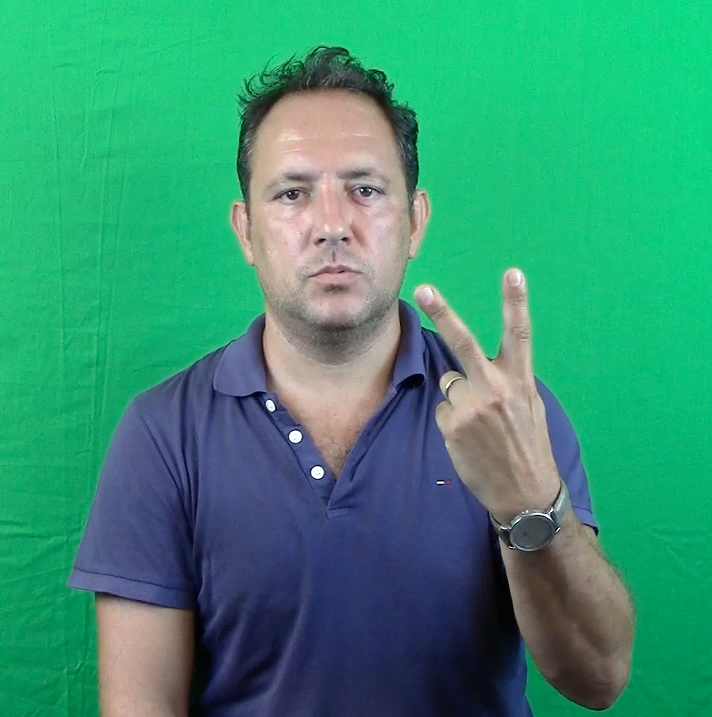
two (citation form)
However, if two is followed by week, a two-handed sign requiring outward palms, it can assimilate its orientation.

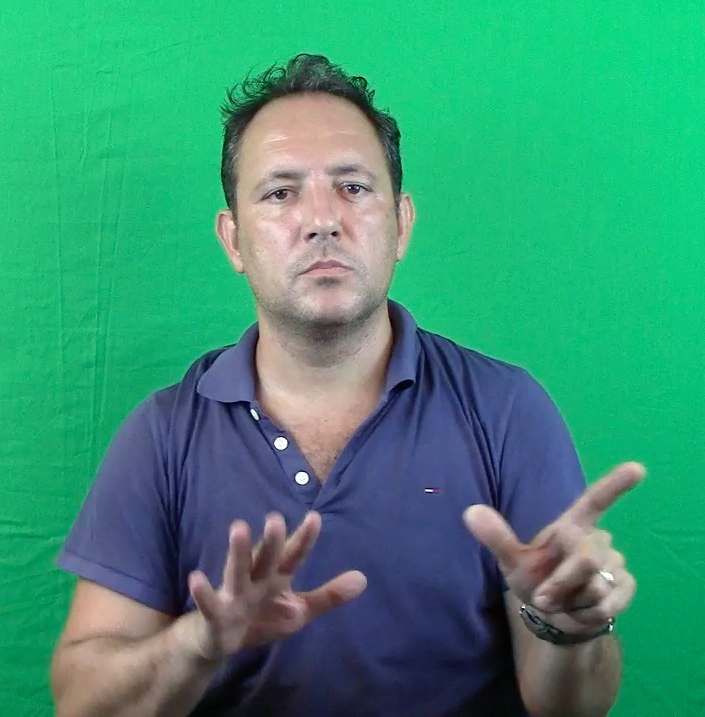
two week
‘Two weeks’
Furthermore, we illustrate the process of location assimilation comparing the two examples below. The aspectual marker done is used to indicate that an event happened before the time of utterance (LEXICON 3.3.1). This sign typically follows the main verb and is produced in the neutral space. As shown in (a), both the verb and done are articulated in an unmarked area in the signing space. However, when done follows a verb that is articulated in a different location, assimilation might occur. As shown in (b), done follows the verb run, which is characterised by a linear contralateral movement. The informant is left handed, so the endpoint of run is in the right area of the neutral space. The sign done assimilates this marked location, and thus is articulated on the right side as well.
a. g-i-a-n-n-i ixa house buy done
‘Gianni bought the house.’ (based on Zucchi, 2017)
b. g-i-a-n-n-i ixa arunb doneb
‘Gianni ran.’ (based on Zucchi, 2017)
Assimilation can also apply to a more local domain. We call this process internal assimilation. Some two-handed signs, whose citation form requires that the hands articulate two different handshapes, can undergo assimilation from the dominant to the non-dominant hand. For example, the two-handed sign week is typically produced with extended 5 on the non-dominant hand and L handshape on the dominant hand (a). Recall that when both hands behave as active articulators in two-handed signs, they typically share the same handshape (PHONOLOGY 1.4.1). This sign is articulatory exceptional because, although both hands move, two different handshapes are used: 5 in the non-dominant and L in the dominant hand. In a variant of week, the non-dominant hand takes on the handshape of the dominant hand (b). As a result, the L handshape is employed by both hands. This assimilation process might be motivated by the principle of ease of articulation.
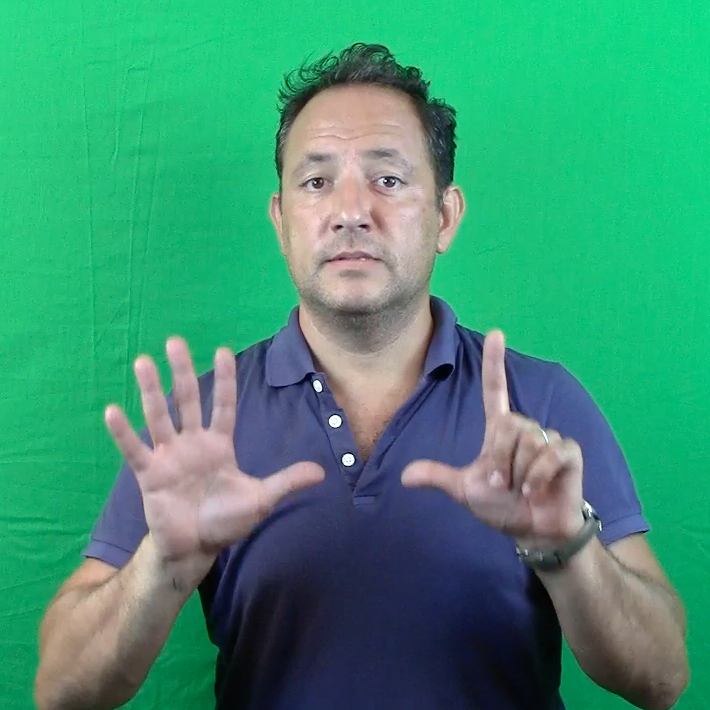
a. week (citation form) (recreated from Radutzky, 2009: 21)
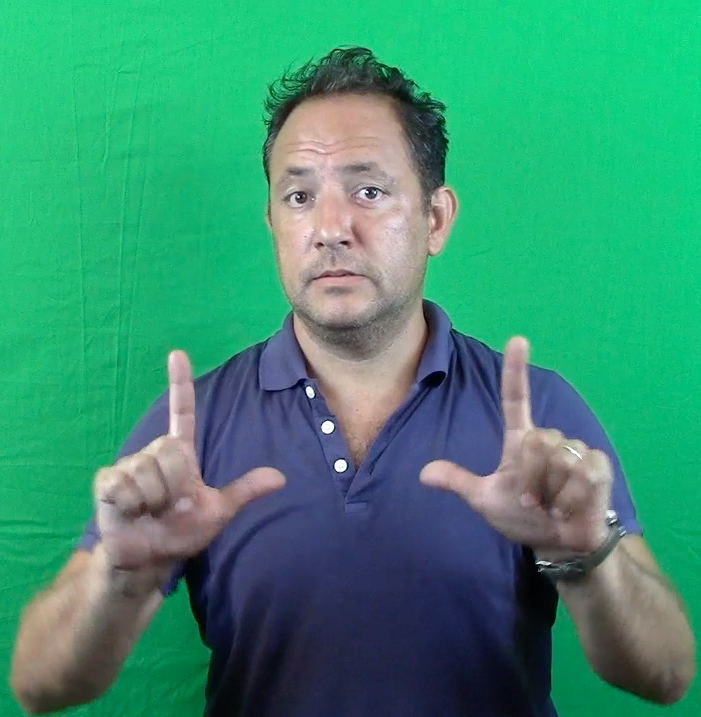
b. week (assimilation) (recreated from Radutzky, 2009: 21)
Internal assimilation can also occur in asymmetrical two-handed signs, i.e. signs produced by both hands in which only the dominant hand behaves as active articulator. For example, the verb try in its original form is produced with extended 5 on the non-dominant hand and V handshape on the dominant hand, which is the only hand moving (a). In a variant of try, assimilation occurs from the handshape of the dominant to that of the non-dominant hand (b). As a result, the V handshape is used by both hands.

a. try (citation form) (recreated from Radutzky, 2009: 20)

b. try (assimilation) (recreated from Radutzky, 2009: 20)
3.1.2. Coalescence
Coalescence is a phonological process that merges two phonological segments into a single one. This typically occurs in spontaneous signing when a symmetrical two-handed sign merges with a pointing sign.
For instance, let us consider the sign classroom. In its citation form, it is a symmetrical two-handed sign (PHONOLOGY 1.4.1) because the dominant and non-dominant hands share the same handshape (extended unspread 5) and secondary movement (flattening).
classroom
In spontaneous discourse, the sign classroom can merge with a locative pointing sign, ix(loc), thus producing an instance of coalescence. The sentence below exemplifies this phenomenon.
classroom^ix(loc) student male three
‘In this classroom, there are three male students.’
Taking a closer look at the coalesced form classroom^ix(loc), we can observe that at the beginning the sign classroom is produced by the two hands, as in the citation form. This sign requires the two hands to undergo handshape change: specifically, the selected fingers should flex at base joints.

classroom^ix(loc) (before fusion)
By effect of coalescence, in the transition between the two handshapes, the dominant hand does not undergo flattening as the non-dominant hand, rather, it changes its shape producing the typical handshape of locative pointing signs, that is extended index finger.
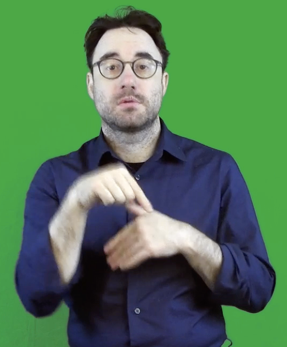
classroom^ix(loc) (after fusion)
3.1.3. Movement reduction and extension
In some cases, LIS signs can undergo movement modification. Specifically, in the modified form, the movement component can be either reduced or extended, thus consisting in smaller or larger movements with respect to the citation form.
Movement modification can be motivated by several linguistic as well as extra-linguistic factors. Morphological processes, such as pluralisation (MORPHOLOGY 4.1) and deverbalisation (MORPHOLOGY 2.1.2.1), might have an impact on the movement component. Movement reduction may be motivated by a drive toward articulatory ease and effort reduction. On the other hand, external factors that may cause reduced movements are space limitations (e.g. video chatting) or situational restrictions on intended audience (i.e. whispering mode). Instead, movement extension may be motivated by emotions such as excitement and anger (i.e. shouting mode), emphasis, or special registers (e.g. child-directed signing).
Generally speaking, movement can involve different articulatory joints: the shoulder, the elbow, the radioulnar, the wrist, the base joint (the knuckles which connect the digits to the hand) and the interphalangeal joints (the knuckles at the midfinger). It is important to distinguish two different types of movement modification: i) reduction or extension occurring at the same joint where movement is produced in the citation form and ii) reduction or extension occurring at a different joint. These two categories are described in detail in the next sections.
3.1.3.1. Without joint shift
Considering movement modification without a switch of the articulatory joint, we present a couple of LIS examples, one involving reduction and the other extension.
Movement reduction can be observed in some cases of plural reduplication morphology (MORPHOLOGY 4.1). Some nouns articulated in the neutral space can be pluralized by repeating the sign at differ points in space. To illustrate, we show below the sign city as well as its plural form city++.
a. city
‘City’ (based on Volterra, 2004: 187)
b. city++
‘Cities’ (based on Volterra, 2004: 188)
The sign city is articulated with a downward path movement realised at the elbow joint. The pluralized form, city++, requires this movement to be repeated at different points in the neutral space. As a result, the movement of the sign is still realised at the elbow joint, but it is phonologically reduced.
Movement extension can be found in pointing signs. Consider, for example, pointing signs expressing locative information, such as (a). If the signer wants to point toward a specific locus at the periphery of the signing space, the pointing sign must be articulated with movement extension, as in (b).
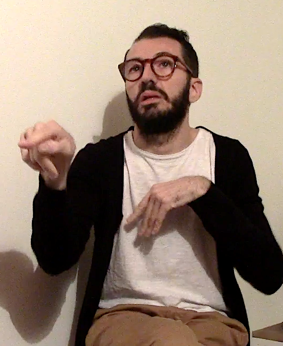
a. ix(loc)
‘There’
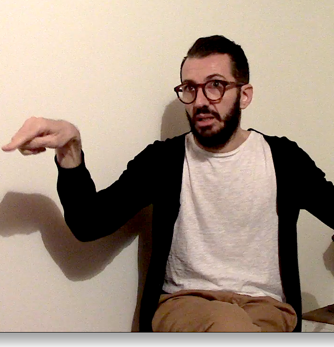
b. ix(loc)[distal]
‘Over there’
3.1.3.2. With joint shift
Some instances of movement reduction or extension can involve a joint shift. This shift can occur in two directions: either to a joint closer to the signer's torso (i.e. proximalisation) or to a joint that is further away from the signer's torso (i.e. distalisation).
On the one hand, proximalisation results in movement extension, since the sign is produced by a bigger articulator. An example of proximalisation is the LIS sign cherry. This sign iconically derives from Italian children's habit to tuck bunches of cherries behind their ears. For this reason, its original form required the index and middle fingers to grasp the back of the ear. For ease of perception, the grasping component is usually substituted by a movement at the wrist or even elbow joint.
a. cherry (original form)
b. cherry (proximalisation)
Other signs undergoing a similar process of proximalisation are birthday and hearing_aid.
Proximalisation can also be used to express particular emphasis. This is exemplified below by the sign fun: in its citation form, the movement is realised at the wrist joint (a), while in the emphasized form, the movement can be realised at the elbow joint (b).
a. fun (citation form)
b. fun (proximalisation)
On the other hand, distalisation results in movement reduction, since the sign is produced by a smaller articulator. An example of distalisation is the LIS sign volleyball. In the citation form, this sign is articulated with a repeated forward movement realised at the elbow joint (a). This type of movement iconically reflects the way volleyball players use their arms to pass the ball. An alternative version of volleyball employs a more distal movement, realised at the wrist joint (b).
a. volleyball (citation form)
b. volleyball (distalisation)
From a purely articulatory perspective, moving distal joints (e.g. finger knuckles) generally requires less physical effort than moving proximal joints (e.g. shoulder and elbow). To favour ease of articulation, signers tend to use distal articulation more often than proximal articulation. However, it must be noted that distal movements require more motor skills and control than proximal movements.
3.1.4. Weak hand drop
Sometimes, LIS signers may realise two-handed signs by using the dominant hand only. This phenomenon involving articulatory reduction is usually referred to as weak hand drop. This phonological process is optional and, according to our informants, it is typically observed in rapid or relaxed signing. An example of weak hand drop in LIS is provided below.
a. life (citation form)
b. life (weak hand drop)
The citation form of the sign life requires both hands to move downward on the signer’s torso, as shown in (a) above. As a result of weak hand drop, this sign can be realised with the dominant hand only, as in (b) above, with no change in meaning. Another two-handed sign that can undergo weak hand drop is dirty. In the examples above showing weak hand drop, the sign life is realised with the right hand by a right-handed signer, while the sign dirty is realised with the left hand by a left-handed signer.
a. dirty (citation form)
b. dirty (weak hand drop)
Weak hand drop in LIS is constrained by both phonological and semantic factors. From a phonological perspective, this process is observed more frequently in symmetrical two-handed signs (PHONOLOGY 1.4.1), i.e. signs in which both hands move, such as life and dirty. Some of the signs belonging to this category, such as kitchen, involve alternating movement, rather than synchronic movement of the hands. In these cases, weak hand drop is unlikely to occur.
kitchen
Weak hand drop appears to be more constrained in asymmetrical two-handed signs (PHONOLOGY 1.4.2), i.e. signs in which the weak hand does not move and serves as location. For example, the asymmetrical sign sister cannot be phonologically reduced by weak hand drop.
sister
However, it should be noted that other asymmetrical two-handed signs seem to allow the deletion of the non-dominant hand. Further research is needed to identify the phonological constraints at play.
Deletion of the weak hand in two-handed signs might be constrained by semantic factors as well. For instance, if the sign conceptually involves two referents or two objects, such as ice_skate (shown below), together, and fight, then one-handed realisation is not allowed.
ice_skate
Weak hand drop is usually blocked if the use of the two hands is iconically motivated. For example, the sign ten is realised by extending ten fingers and hence requires the use of both hands.
ten
3.1.5. Handshape drop
Some LIS signs are articulated with a particular type of secondary movement, namely handshape change. Specifically, the handshape of the sign can undergo opening, closing, flattening, bending, wiggling, rubbing, or spreading movements (PHONOLOGY 1.3.2). Such handshape change might be blocked as a result of a morphological process, giving rise to a phonological process called handshape drop. Typically, the most prominent of the two handshapes involved in the citation form is retained, while the other one is deleted. To exemplify this phenomenon, we consider number inflection both in the verbal (MORPHOLOGY 3.1.2.2) and in the nominal domain (MORPHOLOGY 4.1).
The citation form of the verb warn involves handshape change from closed 5 to extended 3 (a). This sign can be inflected for number to express the meaning ‘(to) warn them/all’. From an articulatory point of view, plural inflection is realised as an arc movement on the horizontal plane (b).
a. warn (citation form)
b. warnarc (handshape drop)
‘(To) warn them/all’
As a result of this morphological process, the sign warn above (b) undergoes handshape drop: during the arc movement, only one of the two handshapes involved is retained, namely extended 3.
In the nominal domain, some nouns involving handshape change may undergo handshape drop as well. For example, the citation form of the noun title requires finger bending from spread V to curved open V, as shown in (a) below. This sign can be inflected for number to express plurality (‘titles’). From an articulatory point of view, plural inflection is realised by reduplication of the sign and simultaneous displacement in the signing space (b) below.
a. title (citation form)
b. title++ (handshape drop)
‘Titles’
As a result of plural inflection, the sign title undergoes handshape drop: during the downward displacement, only one of the two handshapes involved is retained, namely curved open V.
3.1.6. Nativization
Nativisation is a phonological process that may affect some loan signs borrowed from other sign languages, especially those containing phonemic material that is not part of the phonemic inventory of LIS.
For example, this process can be observed in the loan sign workshop, borrowed from American Sign Language (ASL). In its original form, it is articulated with handshape W (a). Since this handshape is not productively used in the LIS lexicon (PHONOLOGY 1.1.3), it is replaced by an articulatory similar handshape included in the phonemic inventory of LIS: extended 4 (b). It is worth noting that, in the nativised form, the association between the handshape of the sign and the first letter of the corresponding spoken language word is lost.
a. workshop (ASL)
(recreated from Lerose, 2012: 43)
b. workshop (LIS)
(recreated from Lerose, 2012: 43)
Such handshape substitution is a strategy used to accommodate this loan sign to the phonological system of LIS.
3.1.7. Metathesis
Metathesis is a phonological process that changes the order of phonemes in a sign. Consider, for instance, those signs requiring the hand(s) to move from one location to another. Generally, the order in which the two locations are reached is fixed (e.g. from location 1 to location 2). In those signs allowing metathesis, this order can be reversed (e.g. from location 2 to location 1). Importantly, such phonological change does not produce any change in meaning.
In LIS, as far as we know, metathesis is attested in a few signs only. Below, we present a couple of examples: patience and facebook. The sign patience involves a change of location, usually from the contralateral to the ipsilateral area of the chest, as in (a). In some cases, the sign undergoes metathesis in that the location change is from the ipsilateral to the contralateral area of the chest, as shown in (b). Crucially, the meaning of the sign remains the same.
a. patience (citation form)
b. patience (metathesis)
A similar case is a variant of the sign facebook. It is articulated by shifting the B handshape from the contralateral to the ipsilateral cheek (a). By effect of metathesis, the order of the two locations can be reversed, i.e. from the ipsilateral to the contralateral cheek, as shown in (b). Crucially, the meaning of the sign remains the same.
a. facebook (citation form)
b. facebook (metathesis)
3.2. Processes affecting the syllable
In sign linguistics, by syllable we intend a single movement, be it primary (or path) or secondary movement (handshape/orientation change) (PHONOLOGY 2.1.1). This section presents those phonological processes affecting the syllable structure of LIS signs. Specifically, epenthesis, syllable reduction, and syllable reanalysis are discussed.
3.2.1. Epenthesis
Epenthesis involves the insertion of phonemic material into a sign. Such phonological process is usually motivated by the need to repair ill-formed syllable structures and hence enhance ease of articulation. This process can affect any of the phonological parameters, but it is most frequently observed with movement. To exemplify epenthesis in LIS, we present one instance of movement epenthesis and one of movement interpolation.
Movement epenthesis occurs in the sign head. In its underlying form, this sign is realised with the G handshape located at the side of the forehead and it does not involve any path movement.
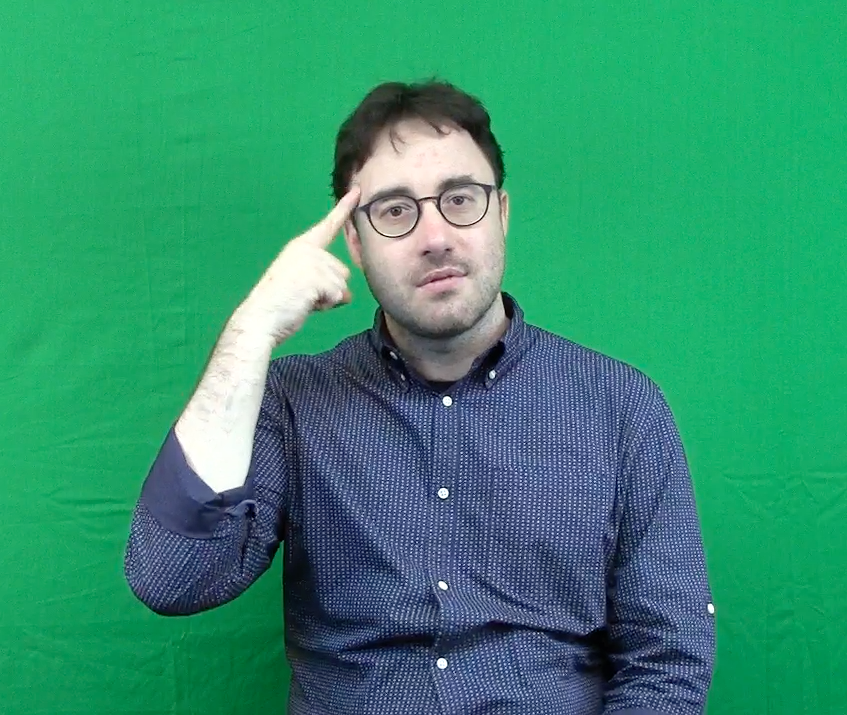
head (underlying form)
(based on Geraci, 2009: 27)
Since movement is an essential component of the phonological structure of signs, the underlying form of head represents a phonotactic violation. To repair such ill-formed cluster and allow articulation in isolation, head requires insertion of movement. As a result of epenthesis, the surface form of the sign head is articulated with repeated path movement toward the signer’s head.
head (surface form)
(based on Geraci, 2009: 27)
Interestingly, when head enters a compound formation, the sonority requirement is satisfied by the other member of the compound, which provides the movement for the entire sign. As a consequence, in this case, movement epenthesis is not required by the sign head. Below, we provide some examples showing that when head appears as first part of a compound, movement epenthesis is not realised.
a. head^transparent
‘Psychology’ (based on Geraci, 2009: 29)
b. head^done
‘Known’ (based on Geraci, 2009: 29)
c. head^empty
‘Absent-minded’ (based on Geraci, 2009: 29)
d. head^ CL(Y): ‘a_lot’
‘Intelligent’ (based on Geraci, 2009: 29)
Movement epenthesis can affect signs articulated in neutral space as well. Consider, for instance, the case of initialised signs, i.e. signs whose handshape represents the first letter of the corresponding spoken language word. An instance is provided by the sign monday (Ita. lunedì), which is realised as an L handshape in neutral space. The underlying form of this sign lacks the movement component.
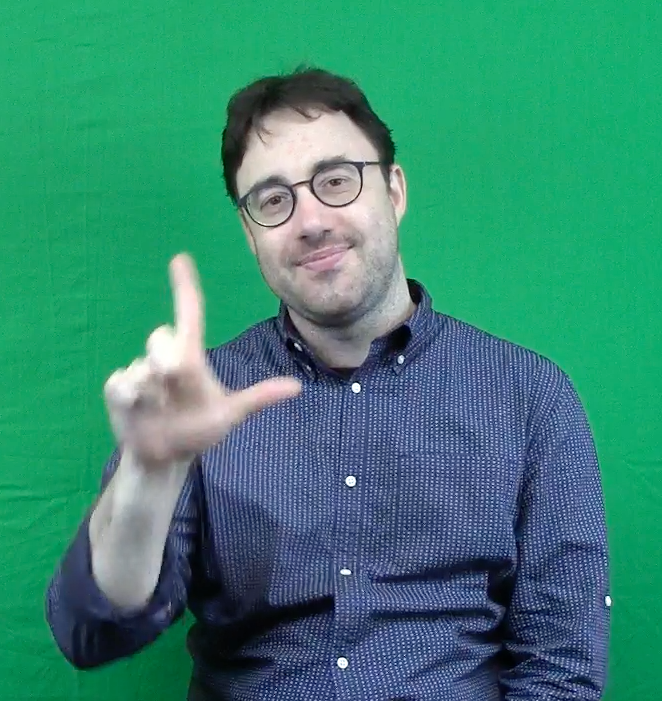
monday (underlying form)
The ill-formedness of monday is restored by the insertion of a circular path movement. Epenthesis can thus be observed in the surface form of the sign when produced in isolation.
monday (surface form)
The sign monday as well as the other signs for the days of the week can combine with the temporal modifier next, which is articulated with a forward arc movement, as shown below.
next
As similarly observed with the sign head, monday loses its epenthetic movement once it is combined with a sign endowed with movement specification. Indeed, the sign resulting from the combination of monday and next retains the movement of the temporal modifier and blocks the epenthetic movement displayed in the surface form of monday.
monday.next
‘Next Monday’
A less typical case of movement epenthesis is represented by movement interpolation. This phonological process implies the insertion of a straight movement in the transition between signs. Below, we show a short sentence including two signs articulated with the dominant hand: the subject woman and the predicate CL(G): ‘individual_move’.



woman transition transition transition



CL(G): ‘individual_move’
‘A woman came up to me.’
In the transition between the two signs, the signer's hand realises a straight movement from the location of the sign woman (close to the cheek) to the initial location of the classifier sign (at a certain point in the ipsilateral space). Note that such transition does not only involve movement interpolation, but also handshape change (from extended 3 to extended G) and orientation change (from outward palm to contralateral palm).
3.2.2. Syllable reduction
Some signs involve two movements repeated in sequence, thus they are made of two syllables. When disyllabic signs are included in compound constructions, they may lose one syllable, i.e. lose one movement. Such phonological process is called syllable reduction.
An example of a disyllabic sign in LIS is the verb eat. In its citation form, it is articulated as a flat closed 5 handshape moving toward the chin with a repeated movement.
eat
When combined with the aspectual marker done, eat may undergo syllable reduction and hence be articulated with one movement only.
eat^done
‘Eaten’
If we compare these two examples, eat included in the compounded construction differs from its citation form in that it is articulated as a monosyllabic sign.
3.2.3. Syllable reanalysis
Some disyllabic signs, i.e. signs with two movements, do not display repeated movement over the same location, rather they require a displacement of the hand(s) from one location to another. As a result of a phonological process known as syllable reanalysis, the transitional movement between the two locations may be reanalysed as the only movement of the sign.
To illustrate, the citation form of the LIS two-handed sign institute is articulated as two F handshapes realising two short path movements: the first one ends with final contact on the higher torso, the second one with final contact on the lower torso. As shown in the video below, this location change is made possible by a transitional downward movement.
institute (citation form)
(based on Geraci, 2009: 16)
In the reanalysed version of institute, the transitional movement between higher and lower torso becomes the only movement of the sign. As a consequence of the deletion of repeated movement, the sign is reanalysed as monosyllabic.
institute (reanalysed form)
(based on Geraci, 2009: 16)
3.3. Processes affecting the prosodic word
In this section, we focus on the prosodic constituent higher than the syllable: the prosodic word. The phonological processes occurring at this level usually have a morphological or syntactic motivation. In this section, reduplication and some effects of cliticisation and compounding are described.
3.3.1. Reduplication
Reduplication is a morphosyntactic phenomenon highly productive in LIS. It can be used to convey several grammatical functions, such as plurality (MORPHOLOGY 4.1), reciprocity (MORPHOLOGY 3.1.3), exhaustivity (MORPHOLOGY 3.1.2.3), and different types of verbal aspect (MORPHOLOGY 3.3). We refer the reader to the aforementioned sections for details about the use of reduplication for morphological purposes.
From a phonological perspective, reduplication can be realised as repetition of the sign without dislocation (simple reduplication), or it can be combined with a shift in the signing space (e.g., sideward reduplication). Simple reduplication can be observed in aspectual modifications. As shown in (a) below, the verb go is a one-handed sign articulated with a simple path movement in the neutral space. This sign can be reduplicated, as in (b), maintaining the same starting point and the same end point to express habitual aspect (MORPHOLOGY 3.3.1.1). This aspectual modification indicates that the event of going to a certain place happened repeatedly over time.
a. go (citation form)
b. go++ (habitual aspect)
‘Used to go’
Sideward reduplication can be observed in the plural form of some nouns: the sign is typically repeated with slight lateral dislocations toward the ipsilateral region of the signing space. To illustrate, we show below the noun villa in its citation form (a) and plural form (b).
a. villa (citation form)
b. villa++ (plural form)
‘Villas’
Reduplication may involve either all phonological components of a sign or some selected features. For example, the noun child is a one-handed sign articulated in the neutral space with a short, repeated movement. When pluralized, the sign undergoes sideward reduplication. In the reduplicated forms, the movement component of child can be phonologically reduced, as in (a), or left unspecified with the sideward dislocation as the only movement of the sign, as in (b).
a. child++ (reduced movement + dislocation)
‘Children’ (based on Bertone, 2011: 99)
b. child++ (dislocation only)
‘Children’ (based on Bertone, 2011: 99)
Reduplication of one-handed signs like child may be realised by both hands. As we can see below, all the phonological features of the sign can be copied onto the signer’s non-dominant hand. The resulting sign is a two-handed sign in which the hands move symmetrically.
child++ (two hands)
‘Children’ (based on Bertone, 2011: 99)
Interestingly, to convey reduplication, the two hands can perform symmetrical movements or, in some cases, alternating movements. The noun tree is a two-handed sign realised with both hands performing an upward path movement. Pluralisation can have two different realisations: the two hands can repeat the sign moving symmetrically, as in (a), or moving in an alternating fashion as independent articulators, as in (b).
a. tree++ (symmetrical movement)
‘Trees’
b. tree++ (alternating movement)
‘Trees’
3.3.2. Phonological effects of cliticization and compounding
Cliticisation consists in the fusion of two words in a syntactic string. As a consequence of this phenomenon, coalescence can be observed (PHONOLOGY 3.1.2).
Differently from cliticisation, compounding is a word formation process that combines two stems (MORPHOLOGY 1). An example of compound in LIS is the sign for parents (father^mother), which combines the stems father and mother.
a. father
(Geraci, 2009: 29)
b. mother
(Geraci, 2009: 29)
c. father^mother
‘Parents’ (Geraci, 2009: 29)
Note that in some regions of Italy other variants of these signs may be used. If we compare the compound father^mother with the citation form of its two stems, we can observe some phonological differences. On the one hand, the signs father (a) and mother (b) exhibit a repeated path movement resulting in disyllabic signs. On the other hand, the two members of the compound (c) both lose their inherent repetition. As a result of compounding, deletion of phonological material is thus observed. This usually has an effect on duration in that the compound form tends to be shorter than the two input signs stringed together in a phrase. Another phonological effect of compounding is that the transitional movement from the handshape of the first stem to that of the second stem is reanalysed as the main movement of the compound.
For more details about the characteristics of compounds in LIS, the reader is referred to the relevant sections in the Morphology part (MORPHOLOGY 1).
3.4. Processes affecting higher prosodic units
This section presents some phonological processes affecting prosodic units larger than prosodic words. Specifically, we discuss issues related to the organisation of the signing space as well as differences in the whispered and shouted registers.
3.4.1. Organization of the signing space
The organisation of the signing space (PRAGMATICS 8) in LIS is highly connected with grammar. Indeed, some constructions capitalize on space to convey precise syntactic meanings. To illustrate, we discuss how three different linguistic phenomena affect the use of the signing space: involvement of multiple discourse referents (PRAGMATICS 1), subordination (SYNTAX 3.2), and contrastive focus (PRAGMATICS 4.1.3).
When two or more referents are involved in a signing production, they can be distinguished on the basis of the spatial locations they are associated with. In the LIS example below, the signer associates a location on the left side in space with the referent ‘Maria’ and a location on the right side in space with the referent ‘Gianni’.
today ix1 mariaa giannib ix1 1meeta 1meetb done
‘Today I met Maria and Gianni.’
In this example, the referent-location association is realised by leftward and rightward body lean, but it could also be signalled by pointing signs directed toward the relevant locations in space. The locations a and b are relevant to verb agreement: the inherently reciprocal verb meet agrees with first person and the location on the left to express the meaning ‘I meet Maria’ and it agrees with first person and the location on the right to express the meaning ‘I meet Gianni’.
Another linguistic context in which a larger spatial area is likely to be used is subordination. To illustrate, we consider a simple declarative sentence like (a) and a more complex sentence involving subordination like (b).
a. pieroa contract sign
‘Piero signed the contract.’
b. giannia say pierob contract sign
‘Gianni said that Piero signed the contract.’
(based on Geraci & Aristodemo, 2016: 104)
To compare the two sentences in terms of use of space, we show below the spatial location of the referent signing the contract (piero) in each sentence.

a. pieroa (subject of the matrix sentence)
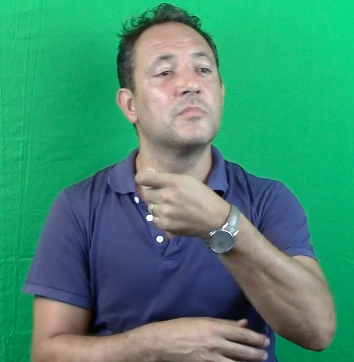
b. pierob (subject of the subordinated sentence)
In the declarative sentence (a), the sign piero is articulated in a, i.e. an ipsilateral point in space, the default location devoted to subjects in LIS. In the sentence involving subordination (b), this ipsilateral location is already occupied by the subject of the main clause (gianni), therefore it is not available to the subject of the subordinated clause piero. The clause embedded under the verb of saying requires additional space to accommodate the referent piero, which is then located in b, a point in the contralateral area.
Contrastive focus is another syntactic construction in LIS that imposes a marked organisation of the signing space. Imagine that someone says that a kid likes tomatoes, but this is untrue according to someone else. A plausible remark containing contrastive focus is provided below.
no. carrot ixa (ix3) like red^SASS(curved open L): ‘round’b (ix3) like.not
‘No, he likes CARROTS, not tomatoes.’
To contrast the two types of referents involved (carrots and tomatoes), the signer is likely to locate them in two distant locations in space, a and b.


a. carrot ixa
‘Carrots’


b. red^SASS(curved open L): ‘round’b
‘Tomatoes’
In this case, the sign carrot is located in a, i.e. a contralateral point in space, through a pointing sign. In contrast, the compound sign red^SASS(curved open L): ‘round’ (MORPHOLOGY 5.2) is localised in b, i.e. an ipsilateral point in space.
3.4.2. Differences in “loudness”: Whispering and shouting mode
The use of the signing space may be affected by register as well. In particular, variation in signing can be observed depending on the identity of the addressee and the extra-linguistic context. In this section, we discuss two register types: whispering and shouting. The whispering mode is usually adopted when the signer communicates in close contact to the addressee and wishes to make the message less noticeable to other people. Conversely, the shouting mode takes place when the message is directed to someone far away and signing is evident and clear on purpose.
To illustrate register differences in LIS, we present the same content expressed in three different ways: spontaneously (a), in shouting mode (b), and in whispering mode (c), respectively.
top
a. president arrive late
‘The president, he is coming late.’ (spontaneous production)
re bl-b
b. attention_getter today president arrive late
‘EXCUSE ME, THE PRESIDENT IS COMING LATE.’ (shouting mode)
eg-shift
c. president arrive late
‘The president is coming late.’ (whispering mode)
Shouting and whispering differ in many respects. In both cases, discourse usually begins by capturing the addressee’s attention. Shouted signing directed to a general audience can be introduced by the following attention-getters: waving the hands from side to side, as in (a) below, or moving them quickly on the midsagittal plane back and forth, as in (b).
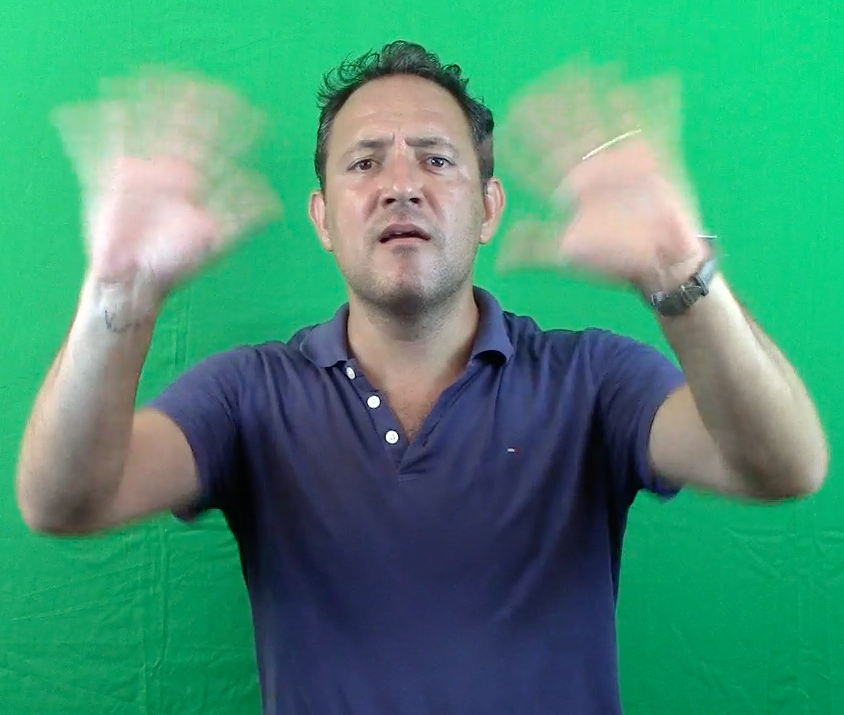
a. attention-getter signal (lateral plane)
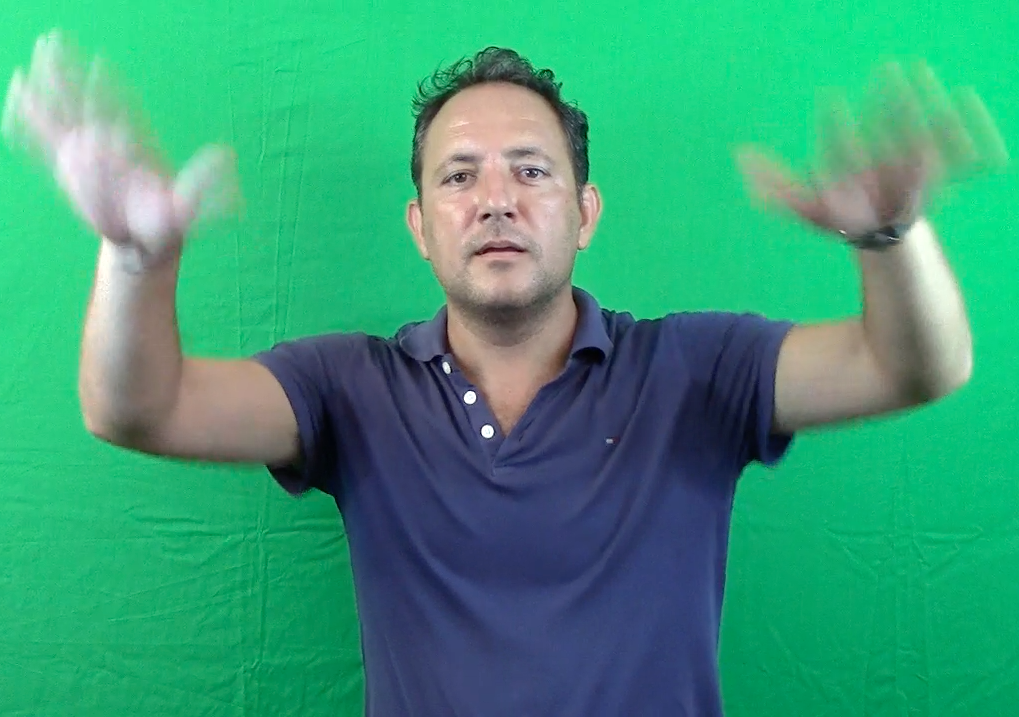
b. attention-getter signal (midsagittal plane)
On the other hand, whispered discourse is directed to one addressee (or a few addressees) only. In order to hide the message from third parties, the addressee’s attention is captured simply by establishing eye contact.
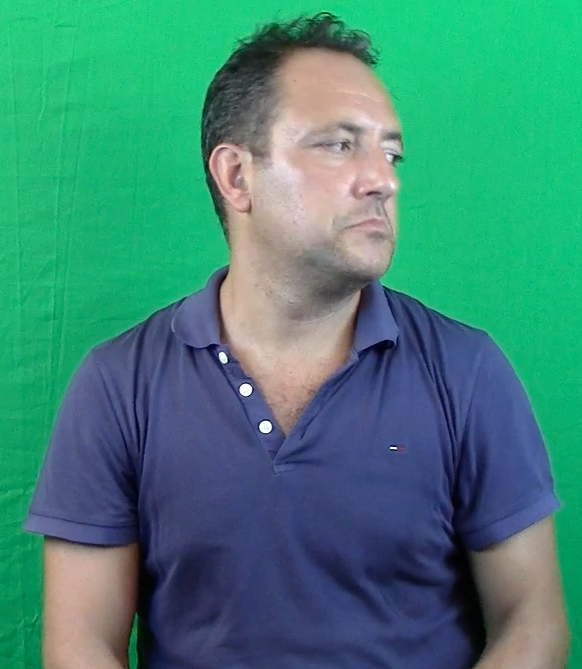
Establishment of eye contact (with someone on the left side)
While whispering, the signer does not necessarily have to maintain eye contact through the whole utterance. In fact, after the initial eye contact as attention-getter, the signer is likely to shift his/her gaze away from the addressee to make the message less noticeable.
The most remarkable difference between shouting and whispering is the extension of the signing space: the former makes use of larger space, the latter of smaller space. The two screenshots below show the same sign (late) articulated in the two registers: in shouting (a), the dominant hand is completely extended in the signing space in front of the signer’s torso; while in whispering (b), the dominant hand articulates the sign in a small area in front of the signer’s lower torso.
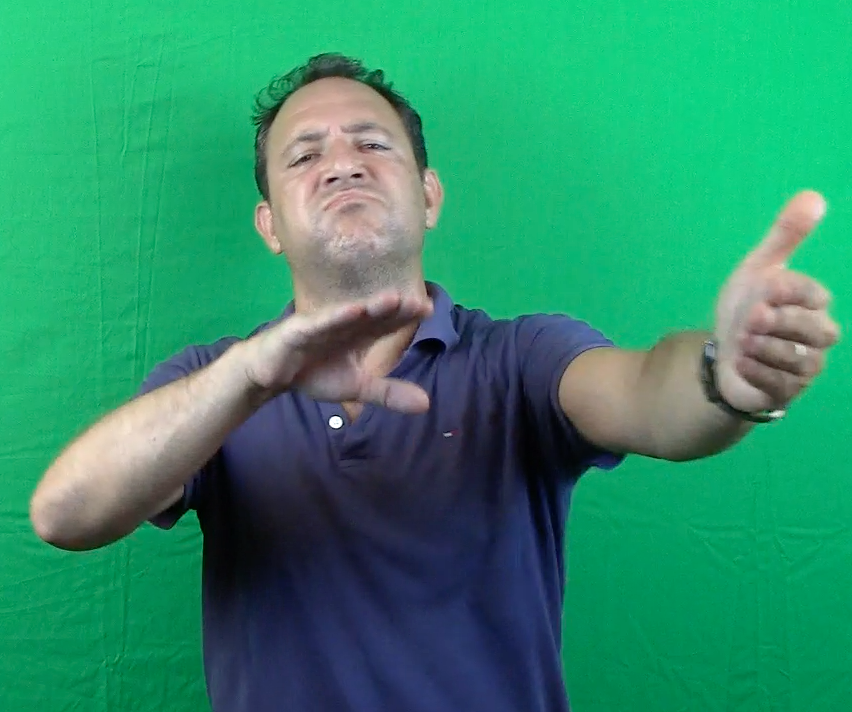
a. late (shouting mode)
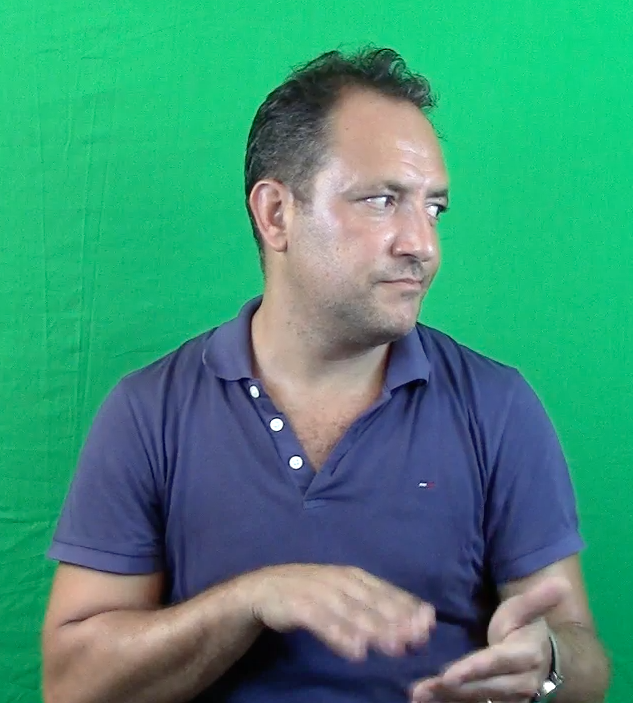
b. late (whispering mode)
Enlarging and shrinking the signing space can influence signing speed. Indeed, the articulation of larger signs generally takes more time than the articulation of smaller signs.
The different use of space is often associated with variations of the amplitude of motion (PHONOLOGY 3.1.3). Typically, movements are proximalised in shouting and distalised in whispering. For example, let us consider the sign president, which is articulated with repeated wrist rotation in its citation form. In shouted discourse, this sign undergoes proximalisation, thus the movement is realised at the elbow joint (a), rather than wrist joint (b).
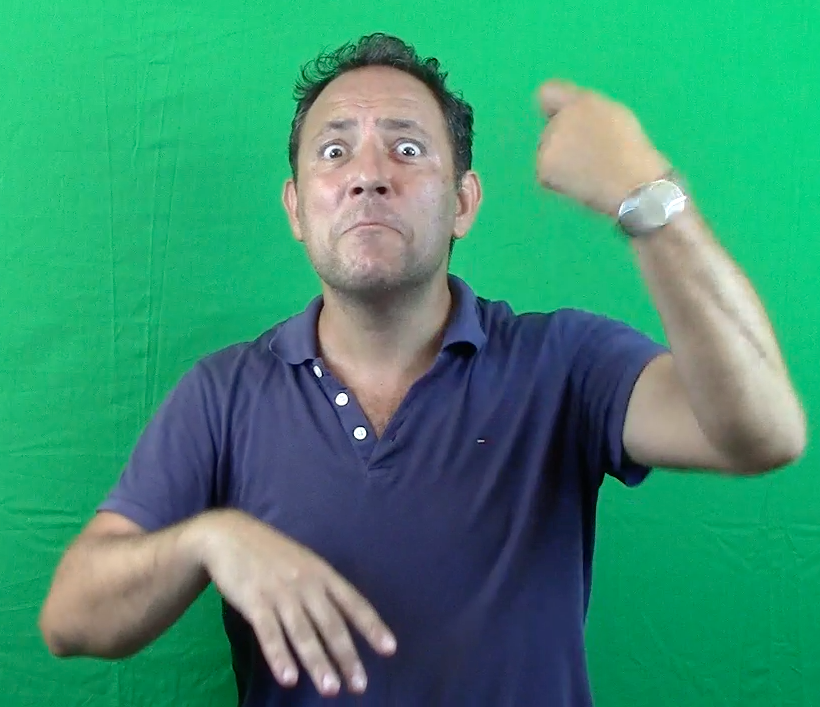
a. president (shouting mode)
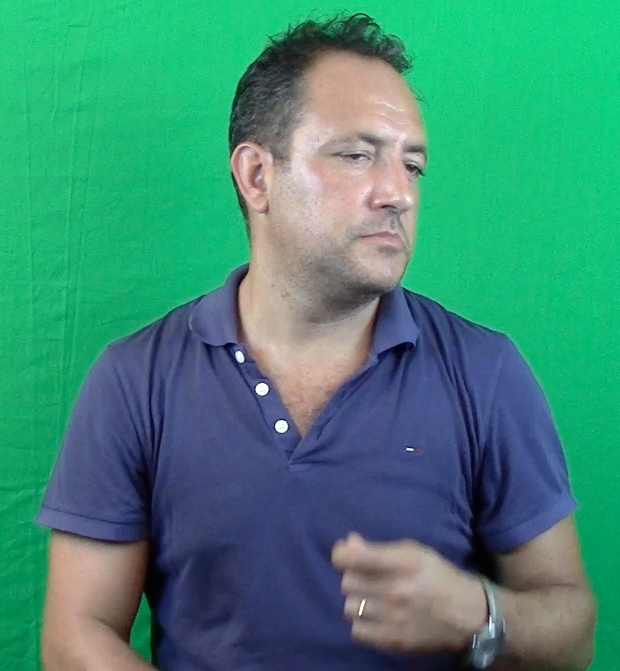
b. president (whispering mode)
In shouted discourse, proximalisation is used to make the sign more evident and easily perceivable over distance.
Another difference in the manual articulation of signs is the more frequent use of one-handed versions in whispered discourse, as opposed to two-handed versions in shouted discourse. For example, the sign arrive is a two-handed sign in LIS. This form is maintained in the shouting mode (a), while it is reduced by weak drop (PHONOLOGY 3.1.4) in the whispering mode (b).
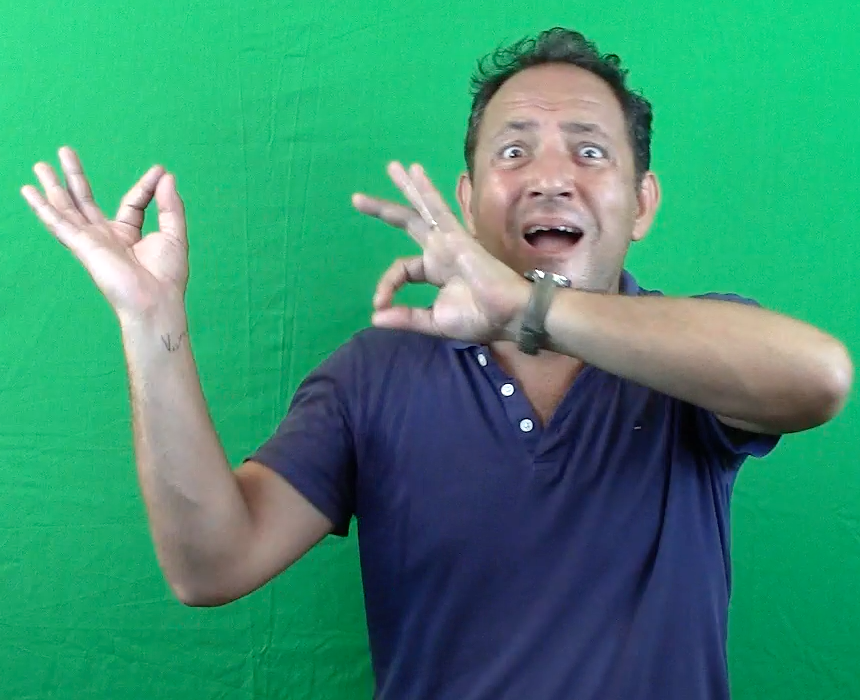
a. arrive (shouting mode)
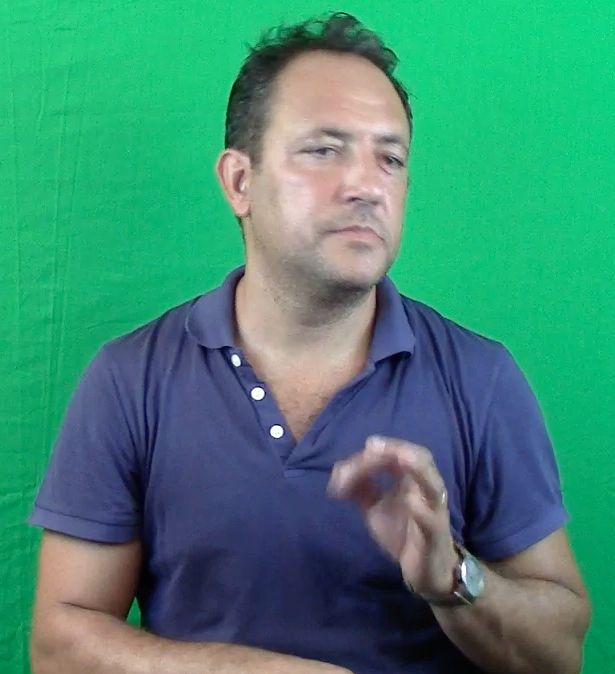
b. arrive (whispering mode)
The screenshots presented in this section show another important difference: typically, shouting involves vivid facial expressions, while whispering is associated with reduced non-manual behaviour. In some whispered productions, however, signers might decide to replace some manual signs with non-manual signals to reduce visibility. For instance, they might point toward a particular location with their eye-gaze or tip of the tongue, rather than using a manual pointing sign (PHONOLOGY 1.1.4).
Information on Data and Consultants
The descriptions in this chapter are based partially on the references below and partially on the elicitation of new data.
The linguistic data illustrated as images and video clips have been checked through acceptability judgments and have been reproduced by Deaf native-signing consultants.
Authorship Information
Lara Mantovan
References
Battaglia, Katia. 2011. Variazione lessicale e fonologica nella LIS. In A. Cardinaletti, C. Cecchetto & C. Donati (eds.), Grammatica, lessico e dimensioni di variazione nella LIS, 189-203. Milano: Franco Angeli. [3.1.1]
Bertone, Carmela. 2011. Fondamenti di Grammatica della Lingua dei Segni Italiana. Milano: Franco Angeli.
Geraci, Carlo & Valentina Aristodemo. 2016. An in-depth tour into sentential complementation in Italian Sign Language. In A. Herrmann, R. Pfau & M. Steinbach (eds.), Complex Matters: Subordination in Sign Languages, 95–150. Berlin: De Gruyter Mouton.
Geraci, Carlo. 2009. Epenthesis in Italian Sign Language. Sign Language & Linguistics 12(1). 3–51. [3.2.1], [3.2.3], [3.3.2]
Lerose, Luigi. 2012. Fonologia LIS. Tricase: Libellula Edizioni. (16-44) [3.1.6]
Mantovan, Lara. 2017. Nominal modification in Italian Sign Language (LIS). Berlin: De Gruyter Mouton. (162-169) [3.1.1]
Mantovan, Lara, Beatrice Giustolisi & Francesca Panzeri (2019). Signing something while meaning its opposite: the expression of irony in Italian Sign Language (LIS). Journal of Pragmatics 142. 47-61. [3.1.3.2]
Pizzuto, Elena & Serena Corazza. 1996. Noun morphology in Italian Sign Language (LIS). Lingua 98. 169-196. [3.1.3.1], [3.3.1]
Radutzky, Elena. 1989. La lingua italiana dei segni: Historical change in the sign language of deaf people in Italy. New York: New York University, PhD dissertation. (107-185) [3.1.1], [3.1.3]
Radutzky, Elena. 2009. Il cambiamento fonologico storico della Lingua dei Segni Italiana. In C. Bertone & A. Cardinaletti (eds.), Alcuni capitoli della grammatica della LIS. Atti dell’incontro di studio, 16 e 17 maggio 2007, 17–42. Venezia: Editrice Cafoscarina. [3.1.1], [3.1.3]
Volterra, Virginia (ed.). 2004. La Lingua dei Segni Italiana. La comunicazione visivo- gestuale dei sordi, 2nd edition. Bologna: Il Mulino. (187-189) [3.1.3.1] and [3.3.1]
Zucchi, Sandro. 2017. Fonologia dei segni. Lecture given at Università degli Studi di Milano, unpublished material. [3.1.1]