The Philia facies and the Interaction Between Cyprus and Cilicia
The Transformations in the Architectural Structures
Abstract The Philia facies marks the transition between the Late Chalcolithic and the Early Bronze Age in Cyprus (2400-2350/2200 BC). This crucial period witnessed significant changes in architecture, craftsmanship, funerary practices, and the economy, attributed to groups from southern Anatolia, particularly Cilicia. This analysis focuses on the study of architectural remains and planimetric changes, specifically comparing structures from certain Cypriot sites with architectural remains found at some Anatolian sites, with the aim of exploring the Cyprus-Anatolia connection through an innovative approach to architectural evidence.
Keywords Protohistoric Archaeology. Cyprus. Anatolia. Philia facies. Architecture.
1 Introduction
This paper has two primary goals. To begin with, it seeks to thoroughly examine the architectural structures found in various Cypriot settlements attributed to the Philia facies (Kissonerga-Mosphilia, Kissonerga-Skalia, and Marki-Alonia), dating approximately from 2400-2350/2200 BCE,1 along with evidence from the subsequent Early Cypriot (EC) I-II periods (Marki-Alonia, and Sotira-Kaminoudhia), dated approximately 2350/2200-2100 BCE. This examination aims to observe how architectural changes during the Philia period persisted into later phases. Concurrently, the architectural features of the contemporary Early Bronze (EB) IVA-B period in the Cilician region (Kilise-Tepe, Kinet-Höyük, Mersin-Yumuktepe, and Tarso-Gözlü Kule), situated in the southeastern part of Anatolia, will be analysed.2
would like to thank both Professors Ilaria Caloi and Elena Rova for their valuable advice and support during the writing of this contribution. I express my gratitude to Lindy Crewe, Jennifer Webb, Béréngéré Perello, and the Sotira Archaeological Project for generously granting permission to include the images in this article, enhancing the comprehension of the architectural evidence in Cyprus and Cilicia.
2 Crewe 2015; Dikaios, Stewart 1962; Frankel, Webb 1999; 2013; Harris 1990; Knapp 2008; 2013; Papacostantinou 2013; Peltenburg 1982; 1993.
3 It is important to emphasise the difficulty in correlating different chronologies. In Anatolia, the Early Bronze Age is divided into three phases, while in Syria it is divided into four periods. As for Cyprus, the island has its own separate chronology. Consequently, when attempting to correlate these different chronologies, it may occur that the dating does not perfectly align.
Secondly, this study aims to explore the relationship between Cyprus and the Anatolian peninsula during this era, with a specific emphasis on identifying any Anatolian influences that manifested during the Philia period in Cyprus.
The study analyses the Philia facies focusing specifically on architectural remains. The investigation into architectures both in Cyprus and Anatolia examines several elements: a) the arrangement of structures and rooms, b) the construction techniques employed, with particular attention to walls and floor preparations, and c) the presence and positioning of various domestic installations, such as hearths and workbenches.
A final comparison of the evidence from Cyprus and Anatolia will be presented. This approach aims to deepen the understanding of the level of integration and interaction between Anatolian groups and Cypriot culture during the Philia period.
2 The Philia Facies
The Philia facies correspond to a brief transitional phase, ranging from 2400-2350/2200 BCE, marking the shift from the Late Chalcolithic period to the onset of the Early Bronze Age in Cyprus.
The first definition of this phase was introduced by Porphyrios Dikaios in 1946 following his archaeological investigations at Philia-Laksia tou Kasinou site,3 located in the northern part of the island. These investigations led the scholar to identify several similarities, characteristic of a facies that would later be named after the homonym site, Philia, and interpreted as the initial manifestation of the Bronze Age in Cyprus.4
4 Dikaios 1946.
5 Dikaios, Stewart 1962, 269-70; Frankel, Webb 1999-2006. For more information about the definition of the facies and the ongoing debate regarding chronological subdivision, refer to Bachhubber 2014, 142-4; Bolger 2007, 164-70; Bombardieri, Graziadio 2019, 41-6; Crewe 2014, 138-9; 2015, 133-5; Frankel 2000, 179-80; Frankel, Webb 2008, 288-90; 2011, 31-5; 2013; Harris 1990, 16-19; Swiny 1985, 115; Swiny, Rapp, Herscher 2003, 3; Webb 2013, 135-7.
Despite the brevity of this chronological period, several significant and innovative changes are evident in technologies, economy, and society, in various archaeological sites, primary located in the northern part of the island, within a specific region known as Vasilia.
However, the identification of the Philia archaeological sites within Vasilia region has not always been straightforward. A major challenge in the study of Philia architecture is its poor preservation. The Philia facies represents a very brief phase, posing difficulties in identifying archaeological levels that can be attributed to this period. In fact, many settlements established during Philia endured for a considerable period, leading to the obliteration of older levels by subsequent phases, and architectural structures were often modified over time. Furthermore, due to the political situation in Cyprus following the Turkish occupation in 1974, archaeological investigations in the northern part of the island and the Vasilia region are impossible. Therefore, this situation makes it very difficult to achieve a comprehensive understanding of the facies.5
6 Crewe 2015, 131-3.
In recent years, research on the Philia facies has made significant progress, with a focus on the investigation of settlements located in the central and southern areas of Cyprus. Thus far, 20 sites,6 comprising both settlements and necropolises, have been confidently attributed to the Philia facies. An additional 14 sites of uncertain attribution,7 can also be considered. Among these archaeological sites, the majority are necropolises, whereas evidence related to settlements is limited and often incomplete. Only six settlements8 are conclusively linked to the facies, among which Kissonerga-Mosphilia, Kissonerga-Skalia, and Marki-Alonia boast the most well-preserved architectural structures [fig. 1].
7 The settlement and necropolis of Bellapais-Vounourouthkia, necropolis of Dhenia-Kafkalla, necropolis of Episkopi-Bamboula, necropolis of Khrysiliou-Ammos, settlement and necropolis of Kissonerga-Mosphilia, settlement of Kissonerga-Skalia, settlement of Kyra-Alonia, necropolis of Kyra-Kaminia, settlement of Marki-Alonia, necropolis of Marki-Davari, necropolis of Vounaros/Pappara, necropolis of Nicosia-Ayia Paraskevi, settlement of Philia-Drakos B, necropolis of Philia-Laksia tou Kasinou, settlement of PhiliaVasiliko, necropolis of Philia/Vasiliko-Kafkalla, necropolis of Sotira-Kaminoudhia A-B, necropolis of Vasilia-Kafkallia and Kilistra, necropolis of Vasilia-Loukkos Trakhonas and the necropolis of Vasilia-Alonia. Frankel, Webb 1999, 7-13.
8 Settlement of Ambelikou-Ayios Georghios, necropolis of Anoyira-Trapezi, necropolis of Arpera Chiflik-Mosphilos, necropolis of Kalavasos-Arkangelos, necropolis of Kalopsidha-Tsaodhi Chiflik, Lefka/Peristerona, Orga-Palialonia/Ambelia, necropolis of PolisKokkina, settlement of Sotira-Kaminoudhia, necropolis of Tokhni-Latones, settlement of Vasilia-Klaodomandra, settlement of VasiliaKoukkoulina, necropolis of Vasilia-Myliades and Yala. Frankel, Webb 1999, 7-13.
9 The other three settlements are: Bellapais-Vounourouthkia, Kyra-Alonia and Philia-Vasiliko. Additionally, there are five more Philia settlements that are less certain but should be considered for inclusion in the list: Ambelikou-Ayos Georghios, Philia-Drakos B, SotiraKaminoudhia, Vasilia-Klaodomandra and Vasilia-Koukkoulina. Crewe 2015, 133; Frankel, Webb 1999, 7-13.
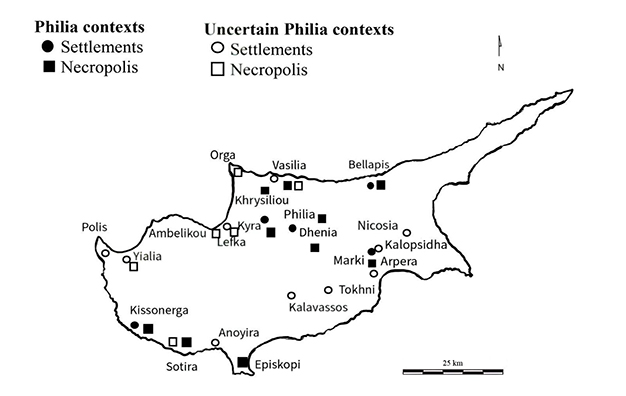
Figure 1 Map of Cyprus indicating Philia and uncertain Philia contexts
One of the most noticeable changes occurring during the Philia facies is evident in the appearance of rectilinear architectures replacing the monocellular circular houses characteristic of the Late Chalcolithic period. Along with the introduction of these new architectural layouts, domestic features such as hearths and workbenches also undergo some modifications, which will be further analysed in the article. Other innovative elements in the material culture of Philia encompass such as ceramic production, metallurgy, the creation of ornamental objects, changes in the economy, and shifts in funerary practices.
The pottery production of the Philia facies has garnered considerable scholarly interest,9 with recent contribution by Frankel and Webb delving into the diffusion of pottery classes associated with Anatolian productions.10 The most significant ceramic ware in terms of diffusion and variety of repertoire is the Red Polished Ware. From this class, other variants develop, including the Red Polished Coarse, the White Painted, the Black Slip and the Combed Ware. The Red Polished Ware,11 characterised by its long spouts and geometric patterns, bears resemblance to materials from EB III–IV at the Karataş12 site and EB II-III fragments from Tarsus.13 Because of this, its features can be tracked back to a southwestern Anatolian influence. This ceramic exhibits a shiny red surface with engraved (rarely applied) geometric decorations filled with white chalk paste, creating a striking chromatic contrast with the red-polished background.
10 Dikaios, Stewart 1962.
11 Refer to Webb, Frankel 1999; 2008; 2013.
12 Bolger 2007, 177-9; Dikaios, Stewart 1962, 223-5; Frankel, Webb 1999, 14-31; 2008, 288-90; 2013, 64-70; Knapp et al. 1990, 149-55; Manning 1993, 48-9. For additional information regarding the other pottery classes, refer to Swiny 1985.
13 Frankel, Webb, Eslick 1996, 42; Mellink 1991, 170-2.
14 Knapp 2013, 270; Mellink 1991, 170-2.
The Philia period witnesses the emergence of innovative metal14 and ornamental objects,15 suggesting the presence of a copper trade network within the island, as well as connections with Cycladic islands16 and the rise of dominant groups within local communities. The most precise comparisons are found in south/western and central Anatolia, particularly at the Karataş-Semayük site, with materials dating to the beginning of EB II through the end of EB III in the local periodisation.17
15 Including spearheads, daggers, axes, spiral-shape earrings, hollow axe-shaped items, and ring-shape ingots. Frankel, Webb 1999, 31-3.
16 The more commonly attested types of objects are annular pendants (mostly made of picrolite), copper rings, and spiral-shaped earrings. Crewe 2015, 137; Frankel, Webb 1999, 34; 2004, 2-7; Dikaios, Stewart 1962, 274-7; Swiny, Rapp, Herscher 2003, 3-5.
17 For one dagger found in Karmi-Palealona, its Cycladic provenance has been confirmed. Regarding the hollow axe-shaped items and ring-shaped ingots, they can be compared to objects originating from the Milyes deposits on Kythnos.
18 Frankel, Webb, Eslick 1996, 43; Mellink 1991, 173.
Economic changes during Philia are most noticeable in agriculture and weaving activities. The most significant modifications are observed in agricultural production, including the introduction of the ox-drawn plough18 and the arrival of new animal species in Cyprus, which led to the advent of animal husbandry.19 The new agricultural tools resulted in a substantial increase in production and, consequently, major changes in labour and social organisation. Similarly, the widespread use of biconical spindle-whorls20 reflects the introduction of a new method of weaving known as low whorl spinning, underscoring the importance of textile production within Cypriot communities. Affinities between samples from Cyprus and Anatolia are not entirely precise, nonetheless, they suggest a considerable transformation in textile production on the island, possibly involving the exchange of both new technologies and textile fibres already known in Anatolia.21
19 Dikaios, Stewart 1962, 288-9; Frankel, Webb 1999, 39; Kouka 2009, 36.
20 Crewe 2015, 144-5; Frankel 2000, 176-7.
21 The spindle-whorls are typically adorned with engraved spiral patterns. These items have been found at several Cypriot sites, including Philia-Laksia tou Kasinou, Philia/Vasiliko-Kafkalla, Sotira-Kaminoudhia, Nicosia-Ayia Paraskevi, Dhenia-Kafkalla, Kissonerga-Mosphilia and Marki-Alonia. Frankel, Webb 1999; Frankel, Webb, Eslick 1996, 43-4.
22 Frankel 2000, 172-6.
Finally, changes are evident in funerary activities and burial practices, particularly in the elaborate chamber tombs of the Vasilia region. These tombs differ significantly from the simple Chalcolithic graves,22 and are characterised by long dromoi providing access to rectangular chambers, often surrounded by lateral niches. During this period, burial kits include not only personal items belonging to the deceased but also status manufacts, such as new ceramic typologies, weapons, and metal objects. These changes may be associated with internal social shifts.23
23 Most found at Aya Paraskevi, pit burials are the most prevalent burial type during the Chalcolithic period. Dikaios, Stewart 1962, 216.
24 Frankel, Webb, Eslick 1996, 46.
3 Architectural Changes and Philia’s Contexts
With the advent of the Philia facies, the emergence of linear architectural structures, replacing the circular single cell houses typical of the Neolithic and Chalcolithic periods,24 marks a significant shift from the previous era.25 Other structural characteristics that define the organisation of these buildings involve alterations in construction techniques, such as the widespread use of mud-brick walls supported by stone plinths. Additionally, domestic features such as hearths undergo a complete transformation in shape and positioning compared to the previous period, now characterised by a rectangular shape and typically situated near the walls. The presence of workbenches, typically situated in a separate room from where the hearth is located, appears to suggest a functional separation of domestic activities within the household, an organisational strategy markedly different from that of the preceding Chalcolithic period.26
25 These houses were constructed using a combination of mud and reeds, resulting in mudwall structures. Peltenburg 1998, 54-6.
26 Dikaios, Stewart 1962, 269-70; Frankel 1998, 244-6; 2000, 180-3; Frankel, Webb 1996, 45-6; 2011, 32-3; Gordon 2005, 122-3; Kouka 2009, 33-7; Kozal 2016, 53-5; Paraskeva 2017, 73-5; Schaar 1985, 40-4; Steel 2004, 128-32; Swiny 1985, 115-16; Swiny, Rapp, Herscher 2003, 3; Webb 2009.
27 Frankel, Webb 2011, 31-2; Frankel, Webb, Eslick 1996, 44-5. During the Chalcolithic period, circular houses featured a single large, rounded hearth positioned at the centre of the dwelling, which served multiple purposes (including lighting, heating, and cooking).
Given the circumstances, only few settlements have been identified, and three of them – Kissonerga-Mosphilia, Kissonerga-Skalia, and Marki-Alonia – boast the best-preserved architectures, forming the focus of the forthcoming discussion.
To provide a clearer understanding of the changes occurring during Philia, which frequently persist into the immediately subsequent phases, evidence related to the succeeding EC I-II periods will also be presented, where architectural evidence permits. Accordingly, the architectural structures dated to EC I-II found at Marki-Alonia (Phases C and D) will be discussed, along with, the EC I structures recovered from Sotira-Kaminoudhia, although not classified as a Philia settlement. This aims to gain a clearer understanding of the transition to the beginning of Bronze Age in Cyprus [tab. 1].
|
Kissonerga-Mosphilia |
Kissonerga-Skalia |
Marki-Alonia |
Sotira-Kaminoudhia |
|
|---|---|---|---|---|
|
Middle/Late Chalcolithic |
Period 4a-b |
|||
|
Philia facies |
Period 5 |
Area D |
Phases A-B |
|
|
EC I |
Phase C |
Area A-B-C |
||
|
EC II |
Phase D |
3.1 Kissonerga-Mosphilia
The extensive settlement is located in the western part of the island and spans a considerable chronological range, from its foundation during the Neolithic phase (late seventh millennium BC) with a major occupation during the Late Chalcolithic and Philia period, when it appears to have been abandoned around 2400/2300 BCE.27 The site covers an area of 12 hectares, and the excavations explored 1600 m2 densely populated by structures organised into two sectors (Main Area and Upper Terrace).
28 Crewe 2015, 133; Frankel, Webb 2011, 31-3; Manning 1993, 39; Papacostantinou 2013, 131-4; Peltenburg 1991, 19-20; 1998, 52.
Edgar Peltenburg28 identified five distinct periods, with only Period 5 associated with the Philia facies. This period exhibits a strong continuity of occupation and a peaceful transition from the Chalcolithic era.
29 Peltenburg 1998.
During the preceding Period 4, Kissonerga underwent a significant reorganisation, which can be divided into two phases, 4A and 4B. Within the older Phase 4A, the Main Area underwent transformation, and various complexes suggest the presence of a more hierarchical society.29 The most notable building from this period is the Pithos House (Structure 3),30 a circular space containing a substantial amount of storage containers (58 pithoi), as well as tools and instruments related to olive oil production.
30 Papacostantinou 2013, 133.
31 Peltenburg 1998, fig. 41.
As Phase 4B approached, dominant architectures vanished – the Pithos House is destroyed by a fire – and the community appeared to regress into a more egalitarian and simplified organisation.31
32 Peltenburg 1998.
Kissonerga appears to transition into the Philia facies and Period 5 without any violent disruptions; instead, several elements suggest continuity:
-
the settlement retains its previous clustered arrangement of houses;
-
on the ruins of the Pithos House, two new structures, 70632 and 86,33 emerge;
33 Structure 706 appears to be a reoccupation of the earlier Pithos House, and probably most of the activities carried out inside were related to metalworking. Peltenburg 1998, 53, fig. 44.
34 Structure 86, characterised by stone walls (Stone House), experienced two phases of occupation, Level 222, and Level 90. Peltenburg 1998, 53, fig. 44.
-
many structures built during Period 4 continue to be used during Period 5, even though none of them is well-preserved.34
35 Peltenburg 1998, 53.
However, some differences can be observed: the lack of storage buildings raises the hypothesis that the community was egalitarian during the Philia period; fire installations, especially ovens, during Philia are predominantly located outdoors; plaster is frequently used as covering for workbenches, floor preparations, platforms, and hearths. Notably, in Period 5, there is a hearth (78) positioned on a circular plastered platform, reminiscent of a typical Chalcolithic type observed at Kissonerga-Mosphilia during Periods 3 and 4.35
36 Peltenburg 1998, 58-9.
During the excavations, an irregular surface (187) was discovered above Structures 3 and 86, which hosted oven fragments (116), a plastered surface (880) and a section of a platform (2103)36 [fig. 3]. Additional ovens (133-5) were found on Surface 132.37
37 In addition to the aforementioned discoveries, a substantial quantity of Red Polished fragments, basins (114-15, 2129) and numerous pits (2133, 50/63) were uncovered on Level 187. Another pit was located adjacent to Platform 2103.
38 Within the quadrant, a pithos grave (504) was discovered.
Throughout Period 5, the presence of Philia markers, such as fire installations, plastered platforms, and floor preparations, is better understood through comparisons of Kissonerga-Mosphilia with other Philia contexts, particularly with Marki-Alonia.
3.2 Kissonerga-Skalia
The site is situated on a hill near the coastline, a bit further south of Kissonerga-Mosphilia.38 Recent excavations39 have unveiled a stratigraphy ranging from the Philia facies to the Early – Middle Cypriot period (2500-1650 BCE).
39 Crewe 2015, 132.
40 Crewe 2015, 131.
The Philia structures are in Area D [fig. 2] and exhibit five levels of floor preparations with some wall foundations, although their preservation status is poor. Originally, these structures had a north-south orientation, but towards the end of the facies, they adopted a different orientation, running northwest/southeast, before being eventually abandoned around 1750 BCE.
The initial buildings, oriented from north to south, had irregular limestone and pebbles foundations with fragments measuring approximately 40-50 cm. These structures featured well-defined rooms with plastered floor preparations, suggesting enclosed environments.40
41 Crewe 2015, 140.
Two elements can be attributed to the Philia period: Structure 681, which originally seemed to have walls developing in elevation, while Structure 879 appears to constitute a typical emplacement element, likely a support for a ceramic container or mortar41 [fig. 3].
42 Crewe 2015, 140.
Deposits of materials overlying floor preparations, dated to the Philia period, are found sealed by subsequent levels. These include ceramic fragments and remnants of small objects.42
43 Crewe 2015, 141.
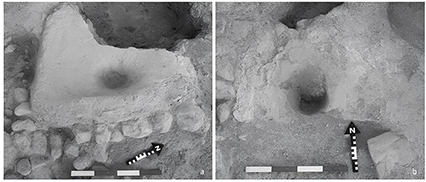
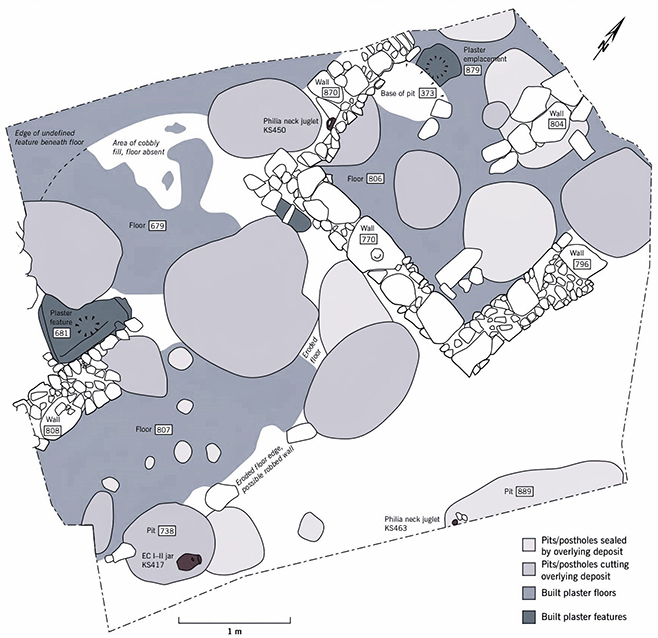
Figure 2 Kissonerga-Skalia, Area D at the end of the excavation campaign in 2014. Crewe 2015, 138, fig. 6
Figure 3 Kissonerga-Skalia, Area D: a. Structure 681; b. Structure 879. Crewe 2015, 139, figs 7a-b, p. 139
3.3 Marki-Alonia
Marki-Alonia stands as a significant settlement from the latter half of the third millennium BC, notable not only for its extensive excavation43 but also for the continuity of its stratigraphical sequence, spanning from the Early Bronze Age to the Middle Bronze Age.44 Located in the central plain of the island, at the northeastern foothills of the Troodos massif, the site reached a maximum extension of approximately 5 hectares over its 500 years of occupation.45
44 The initial research in the region were conducted in 1900 by the Australian Cyprus Expedition, which involved some surface reconnaissance in the Alykos’ river valley. Frankel 1998, 243-4.
45 Papacostantinou 2013, 139-40.
46 Frankel 1998, 244; Papacostantinou 2013, 139.
Among 33 identified architectural units, only three are attributed to the Philia facies (Phases A and B) [figs 4a-b], which have suffered damage from subsequent constructions, excavation of pits, and post holes.
Phase A, dating around 2300 BCE, follows the settlement’s foundation. The two oldest structures in the southwest area of the settlement, Compounds 1 and 2, suffered significant damage. Some postholes, in the northeast portion of the site, suggest temporary structures which likely included workspaces.46
47 Frankel, Webb 2006, fig. 3.41; Webb 2009, 257-8.
In Phase B, single-story buildings with mudbrick walls on stone plinths surround courts47 or open spaces. Communal activities, indicated by large ovens and storage containers, suggest shared use of food and beverages among a large group of people.48 Compound 1 remains unaltered, while Compound 2 is replaced by a structure associated with Compounds 3 and 4, featuring a two-rooms plan and a shared court,49 suggesting a close relation among these houses. They formed a larger nucleus and shared the open space for domestic tasks, primarily centred on cooking, as probably indicates a hearth or bread oven (2468) found adjacent to close to wall 2340.50 Additionally, evidence of artisanal production is attested, such as the working of shells and flint, the crafting of bone tools, and ceramic production.
48 The courts were likely defined by fences or other informal structures.
49 These activities likely involved working with stone, bone, horns, and shells. Frankel, Webb 2000, 486-91; Papacostantinou 2013, 139.
50 Frankel, Webb 2006.
51 Other indicators point towards the working of shells and flint, the crafting of bone tools, and ceramic production.
In the southeastern area, the presence of four pairs of postholes suggests the existence of small fences, and a pithos embedded in the floor contained the burial of a child. Frankel, Webb 2006, fig. 3.42; Knapp 2013, 274; Webb 2009, 258.
The subsequent phases (Phases C and D), corresponding to EC I and II, are better preserved and crucial for understanding the appearance, continuity, and potential reuse of Philia elements [figs 4c-d].
With the onset of EC I (Phase C), there is an increase in population, leading to the expansion or reorganisation of previous structures and to the construction of new compounds, such as Compounds 6 and 7.51
52 New structures (Compounds 6 and 7) were built above earlier Compound 3. Compound 4 is now an enclosed area to the west (Compound 8) and a courtyard to the east, which belongs to Compound 9, imposing on the previous Compound 1. Frankel, Webb 2006, figs 3.43-3.58.
Major changes concerning circular hearths and communal space occur in EC II (Phase D). The circular hearths, some of which are already attested during Phase C, complement the rectangular ones. The courts or open spaces, which appeared during Phase B, now seem to be divided and enclosed on at least three sides by structural walls. The absence of communal spaces and the appearance of houses with well-defined rooms may suggest social differentiation or a greater emphasis on private property.52 This is probably also linked to an increased social complexity within Cypriot communities, which can be associated with greater productivity and perhaps the emergence of increasingly extensive trade networks, particularly related to the circulation of metals. The architectural indicators of the Philia facies, including, rectilinear architectures, specific construction techniques, hearths distribution, and workbenches, imply that a range of activities previously shared and carried out outdoors now took place within each home or involved a smaller number of people.53
53 Frankel, Webb 2000, 483-9.
54 Papacostantinou 2013, 152-3.
3.4 Sotira-Kaminoudhia
The site of Sotira-Kaminoudhia, situated in southern Cyprus, spans nearly one hectare on the southern slope of a hill to the south of the modern city of Sotira-Kaminoudhia.54 Excavations in three areas (A, B and C) [figs 9-10] revealed a settlement with a brief occupation during the Middle Chalcolithic, a significant expansion during EC I, and a tragic end, likely due to a fire possibly triggered by an earthquake.55 The settlement’s architecture has a peculiar aspect, with rectangular units found next to square and triangular rooms and others that even incorporate curvilinear walls.
55 Swiny 1985, 118.
56 Papacostantinou 2013, 140; Swiny 2003, 51; 2008, 44-8. Evidence of a tragic end is found in the skeletal remains discovered within the Kaminoudhia settlement. Specifically, in reference to Unit 44 in Area A, the discovery of a female skeleton, coupled with its position and the absence of grave goods, suggests that she may have been a victim of a catastrophic event, such as an earthquake. Swiny 2008, 45-7.
In Area A [fig. 5], a complex of 2556 adjoined rooms was discovered in the northern part of the site. Each unit seems to be equipped with a rectangular hearth and low, elongated workbenches along the walls in the adjacent room.57 Communal spaces between rooms were narrow, suggesting most activities occurred inside. Notably, two hearths were uncovered, one rectangular plastered hearth in the northwest corner of Unit 6,58 and a double rectangular hearth in the southeast corner of Unit 7.59
57 Among all the units, the best-preserved are Unit 1 and 3, 4, 19 and 20, 6, 7, 40 and 35. Papacostantinou 2013, 156-7; Swiny, Rapp, Herscher 2003, 10-34.
58 In Unit 1, there is the longest workbench, running along three walls. Near the benches, plaster basins (mortars) and coarse pottery, likely used for baking bread, are frequently found. Swiny 1989, 20.
59 The hearth within Unit 6 featured a plaster base capable of hosting a fire measuring 33 × 46 cm.
60 The hearth in Unit 7 was built into the middle of wall WAH, measuring nearly 18 × 32 cm and associated with a working area, indicated by an alignment of stones, which are preserved to a height of 2 metres and a width of 0.50 metres. Swiny, Rapp, Herscher 2003, 23.
In Area B [fig. 6 left], located to the west/southwest of Area A and to the northwest of Area C, significant insights into the site’s abandonment were obtained.60 Of note are two rooms uncovered within this area: Unit 12, and Unit 14.61 Unit 12 comprises a wide, unroofed area with a delimited rectangular court. Interestingly, a copper spiral earring diagnostic of the Philia facies has been unearthed within it, providing evidence of the use of this space during this period. Due to the notable absence of domestic features, such as hearths or workbenches, this space has been interpreted as a ritual space.62
61 Papacostantinou 2013, 157; Swiny, Rapp, Herscher 2003, 34-9.
62 The room was 5.5 × 3.3 × 6.3 m.
63 Swiny 2008, 48-50.
Unit 14 notable for its spacious dimensions and triangular shape, featuring a double hearth in the northern corner.63 The later room represents a particularly unique example due to its distinctive construction technique in one of its walls (WS), which utilises ceramic fragments instead of the typically observed mudbricks.64 Area C [fig. 6 right] revealed five environments: Units 2 and 25, Unit 8, Units 21 and 26. Unit 2 is the largest room with an area of 34 m2 and a slightly quadrangular shape with a cardinal points orientation. In the northern corner of Unit 2, a hearth was found, being the sole one recovered in this area.65
64 The fire next to wall WN was initially 26 cm wide and 38-40 cm deep, and it appears to be slightly separated from the other hearth, which measures 23 cm wide, 22 cm deep and 20 cm in length.
65 Swiny, Rapp, Herscher 2003, 39-42.
66 Swiny, Rapp, Herscher 2003, 39-42.
Unit 8 revealed significant discoveries in the northern corner, including a stone platform,66 a thick lime plaster layer67 likely used as a floor preparation, two platforms and two pits indicating grain grinding/refining and storage of small quantities of food.68
67 The stone platform is 30 cm high and 60 cm thick.
68 The lime plaster layer is 33 cm thick and 60 cm long.
69 Papacostantinou 2013, 157; Swiny, Rapp, Herscher 2003, 42-4.
In the western portion of the area the units exhibit variations in wall thickness. This discrepancy appears to be associated with the functional roles of the walls, distinguishing load-bearing walls from partition walls.69
70 WAR appears like a partition wall in relation to Unit 8 (50 cm thick). The other two walls, WAF and WAJ are 60 cm thick, while the partition wall delineating Unit 26 is narrower, measuring 40 cm in width. Swiny, Rapp, Herscher 2003, 64-6.
In summary, during the Philia period, architectures are characterised by rectilinear organisation and the presence of open spaces between houses for communal activities. With the advent of EC I, these communal spaces appear to lose their significance, likely due to a social reorganisation and increased complexity. During the same period, structures in Sotira-Kaminoudhia housed various domestic installations, such as hearths and workbenches, whose placement suggests that food preparation and cooking took place in different rooms within the house. The main change in Sotira-Kaminoudhia relates to building techniques, featuring stone foundations and walls constructed from stone or ceramic fragments, differing from the typical mudbrick walls found at Marki-Alonia. This variation is attributed to a combination of ancient techniques, innovative technologies, and a focus on structure thickness (see above).70 Analysing the better-preserved EC I structures at Sotira-Kaminoudhia, following the Philia facies, reveals similarities with elements from the Philia period observed in Marki-Alonia and Kissonerga-Mosphilia. These similarities include as well rectilinear rooms, rectangular hearths, workbenches, and plaster floor preparations, all of which are common Philia markers.
71 Swiny, Rapp, Herscher 2003, 64-6.
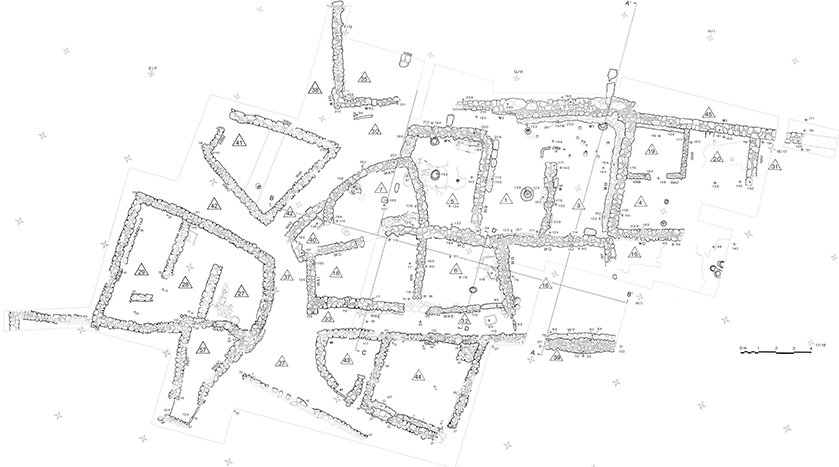
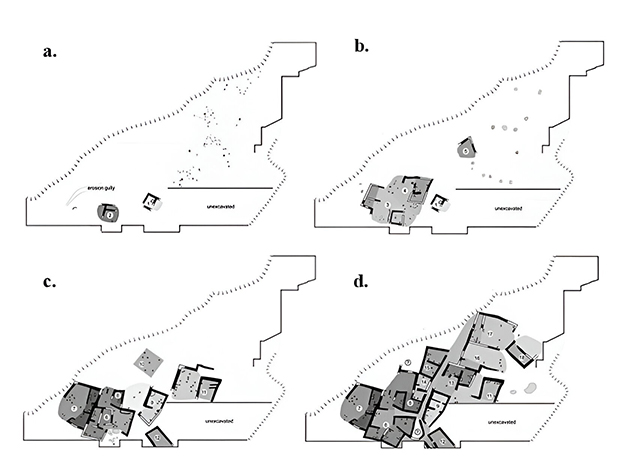
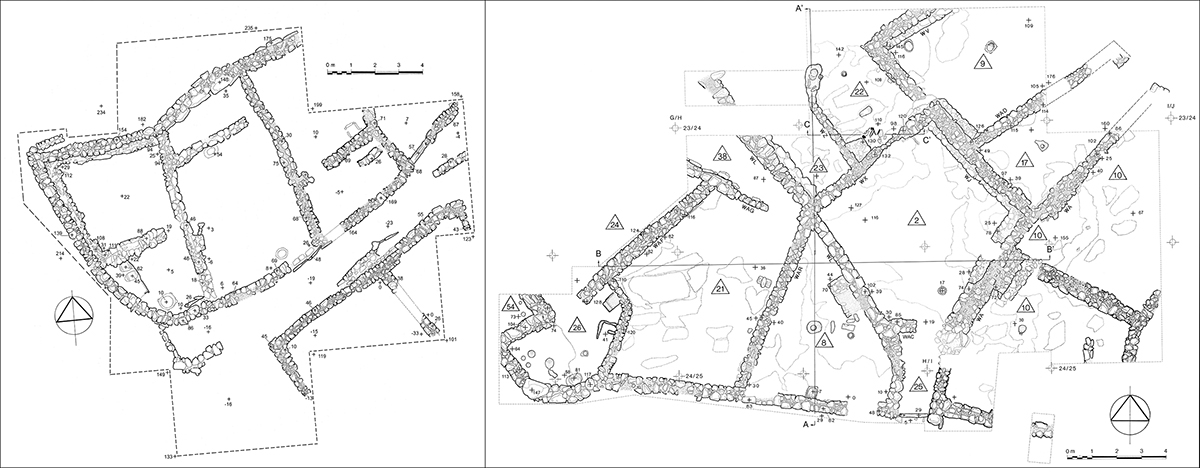
Figure 4 Marki-Alonia settlement phases: a. Phase A (= Philia facies); b. Phase B (= Philia facies); c. Phase C (=EC I); d. Phase D (=EC II). Webb 2009, 258, figs 6a-b; 259, figs 7a-b
Figure 5 Sotira-Kaminoudhia, Area A. Courtesy of the Sotira Archaeological Project
Figure 6 Sotira-Kaminoudhia, Area B (left) and Area C (right). Courtesy of the Sotira Archaeological Project
4 The Cilicia Region
The southeastern Anatolian region, known as Cilicia, is a key focus of this study, which is surrounded by mountains on three sides71 and crossed by three major rivers: Cidno, Seyhan, and Ceyhan. This region is naturally divided into two parts by the Limonlu Çayı: Cilicia Tracheia and Cilicia Pedias.72
72 French 2013, 479.
73 The boundary between Cilicia Pedias and Tracheia is also marked by the Göksu River and a major communication route leading toward the Konya plain, further inland. French 2013, 479; Mellink 1991, 170; Novák et al. 2017, 150-1.
Cilicia Pedias, to the east, comprises a vast alluvial plain of approximately 8,000 km², including portions of the Taurus Mountains and a coastal plain irrigated by the Cidno, Seyhan, and Ceyhan rivers. It is well-known for its fertility73 and plays a pivotal role as a crucial crossroads for north-south and east-west commercial and communication route.74 Additionally, it is known for hosting various settlements located on tells,75 many of which were initially documented by Veronica M. Seton-Williams in the early 1950s.76 Cilicia Tracheia, to the west, includes a substantial portion of the Taurus Mountains,77 and is also known for its historically significant forests supplying Phoenicia and Egypt.
74 Seton-Williams 1954, 121-3.
75 Ancient commercial routes had key settlements located along pathways. Among these, Mersin, Tarso, Adana and Misis. French 2013, 479; Mellink 1972, 165-6; Seton-Williams 1954, 123-4; Wawruschka 2010, 579-80.
76 Artificial mounds of various sizes and heights.
77 Studies by Seton-Williams in 1951 identified eight additional settlement contexts in the Cilicia region. See also French 2013, 480; Seton-Williams 1954, 125-6. Recent investigations have been carried out by Erhan in 2005 and Konyar in 2006. Wawruschka 2010, 579.
78 McMahon, Steadman 2015, 228-9.
The southern Anatolian coast is situated no more than 75-100 km from the northern coast of Cyprus, with the closest point between Anamur and Silifke. Settlements in this area date back to the Neolithic Aceramic period,78 with early use of obsidian from the Anatolian hinterland, transported to Mersin and Tarsus, and likely exported to Cyprus.79 However, obsidian popularity waned rapidly, being supplanted by copper from the Upper Tigris region. This change led to increased copper extraction in the Taurus Mountains during the fourth-third millennia BCE and the spread of new metallurgical technologies in various parts of Anatolia. Combined with a growing demand for metal resources and craftsmanship, this led Anatolia to establish connections with various external entities, including Cyprus.80
79 Mellink 1991, 172.
80 The amount of obsidian found in Cyprus dated to the Neolithic Aceramic is limited. Nevertheless, it serves as an indicator of searoutes from Cilicia to Byblos, occasionally extended to Cyprus. However, it does not suggest the complete inclusion of the island within the Syro-Cilician koiné. Mellink 1991, 173-4.
81 Mellink 1991, 173-4; Yener, Vandiver 1993, 237-8.
The first archaeological investigations in these areas began in the 1930s with Einar Gjerstad, who conducted surveys between Anamur and Misis. Subsequently, John Garstang directed the analysis of settlements like Mersin-Yumuktepe81 and Sirkeli-Höyük.82 In the same period, Hetty Goldman83 began studying Tarsus.
82 Garstang 1953, 1-10.
83 Garstang 1937.
84 Goldman 1956.
More recently, between 1994 and 1998, Nicholas Postgate84 initiated archaeological investigations at the Kilise Tepe site. Between 2004 and 2005 studies in Cilicia Pedias have intensified thanks to scholars Mustafa H. Sayar and Oyman Girginer. However, only few projects have focused on new contexts, and there is an increasing need to establish a chronological correlation among the Cilician archaeological sites. To address this, the first Cilician Chronology Workshop took place in the summer of 2014 at Sirkeli-Höyük, followed by subsequent editions in 2015 at Tatarli and Sirkeli, and in 2017 at the Tarso-Gözlü Kule archaeological research centre.85
85 Postgate 1998, 127-9.
86 Novák et al. 2017, 170.
4.1 EB IVA-B Contexts in Cilicia
The Philia facies in Cyprus corresponds to the Early Bronze Age (EB) IVA-B horizon in Cilicia, dated between 2500-2000 BC [tab. 2].86 It’s noteworthy that at Tarsus a slightly different chronology and nomenclature is used, initially proposed by Goldman [tab. 2]: EB IIA-B is dated between 2700-2400 BCE, and EB IIIA-B between 2400-2000 BCE, in accordance with the periodisation used by Anatolian archaeologists.87 However, for a better correlation between stratigraphies related to the Early Bronze Age in Anatolian contexts, the chronology proposed by Paolo Matthiae will be adopted here.88 This chronology, applied by the scholar in the study of Northwestern Syria, is chosen due to its reliability and the geographical proximity of Cilicia to the latter area. Therefore, it has been decided to adopt Matthiae’s terminology in the analysis of the Early Bronze Age Cilician settlements considered [tab. 3].
87 Matthiae 2013, 181.
88 Goldman 1956; Novák et al. 2017, 162; Perello 2011, 42-3, 288-93. See also Mellink 1965.
89 Matthiae 2013, 181. Refer also to Novák et al. 2017, 182.
In the preceding EB II period at Tarsus there was a notable increase in economic prosperity, marked by the establishment of wide-range relations89 which endured into EB III. However, when viewed across the broader Anatolian mainland during the EB IV period, a less optimistic picture emerges.90 During the EB IV, as highlighted by Bachhubber,91 there was a dramatic decrease in the number of settlements, contrasting with the preceding EB I-II-III periods (3100-2500 BC).
90 These relations included the Amuq region, the trans-Amanus area in northern Syria, and centres in the Taurus Mountains and the plains of Konya and Aksaray. Mellink 1991, 170.
91 Refer to Mellaart 1962.
92 Bachhubber 2014, 143-5.
Many scholars have formulated theories regarding the causes of this crisis on Anatolian land. James Mellart,92 during surveys in the Konya plain, interpreted the decreased number of the settlements as the outcome of a potential migration.93 According to Frankel, Webb and Eslick this period of crisis is believed to have been primarily determined by overexploitation of resources in the Anatolian territory,94 which likely forced many agricultural communities to relocate elsewhere. It was precisely following this period of decline that the relation with Cyprus intensified, in fact, the island would have been a choice motivated by its geographical proximity and the previous relationships established as early as EB II-III.95 Initially, this relationship would have been more occasional and likely involved adult males exploring the island, as evidenced by the discovery of metal weapons and objects. However, with the advent of the EB IV, it would have intensified with the arrival of entire Anatolian family groups in Cyprus, which would have settled on the island, leading to the emergence of the Philia facies and the transmission of knowledge concerning metalworking and craftsmanship.96 Within Cilicia, 43 settlement contexts provide evidence of occupation dating back to the Bronze Age.97
93 Mellaart 1962; Paraskeva 2017, 87-9.
94 Mellaart 1962 suggests that Indo-European populations moving from the Balkans caused the destruction and abandonment of settlements during EB II, leading to a displacement of Anatolian populations from western coastal areas to the eastern part of the peninsula.
95 Webb, Frankel and Eslick support the theory that a combination of natural events, human activities, and social-economic changes contribute to depopulation and land overexploitation to meet growing community demands. Frankel, Webb, Eslick 1996, 47-50.
96 Bachhubber 2014, 139-42, 144-5.
97 Frankel 2000, 179-84; 2005, 22.
98 Alyahanun, Anberinharki, Boz Höyük, Ҫavuşlu, Dervişli, Domuz I, Domuz Tepe, Eşkiler, Geҫemey Höyük, Haci Bozan, Hamzali Buran Ҫiftlik, Hesigin Tepe, Höyük, Imam Oğlu, Kabarsa, Kara Höyük, Kazanli, Kilise-Tepe, Kinet-Höyük, Kizil, Kürkҫüler, Mersin Yumuktepe, Minareli Höyük, Misis, Molla Ahmet, Mustafa Alinin Hüyügü, Nerğis, Pascu Hüyügü, Sirkeli, Sultan Tepe, Tarmil Höyük, Tarso, Tenevardi I, Tepesidelik, Tilan Höyük, Tirmil Tepe, Velican Tepe, Talaközü Hüyük, Yaşil Höyük, Yenice Höyük, Yeniköy II e Zeytinli. Seton-Williams 1954, 147-74.
However, in many of these contexts, the stratigraphy yields only faint traces of the beginning of the Bronze Age, primarily represented by ceramic fragments. Analysis of architectural remains dating to the EB IVA-B phase is possible in only four settlements: Kilise-Tepe, Kinet-Höyük, Mersin Yumuktepe, and Tarso-Gözlü Kule. For each context, when possible, structures related to the EB III and EB IVA-B period (corresponding to Philia in Cyprus) will be presented98 [tab. 3] [fig. 7].
99 Matthiae 2013, 181. Refer also to Novák et al. 2017, 182.
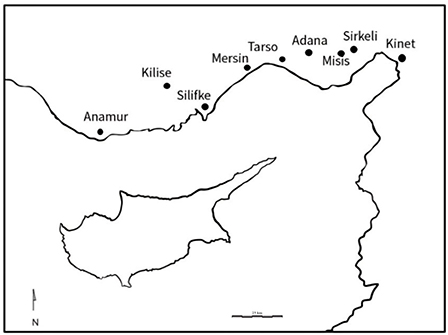
Figure 7 Map showing the position of the mentioned Early Bronze Age Cilician contexts
|
Approximates dates BC |
Cyprus chronological terminology |
Anatolia chronological terminology |
|
|---|---|---|---|
|
Matthiae 2013 |
Tarsus-Gözlü Küle99 |
||
|
2700 |
Late Chalcolithic |
EB III |
EB IIA |
|
2600 |
|||
|
2500 |
EB IVA |
EB IIB |
|
|
2400 |
Philia facies |
EB IIIA |
|
|
2300 |
EC I |
EB IVB |
|
|
2200 |
EB III |
||
|
2100 |
EC II |
||
|
2000 |
MB I |
MB I |
|
|
1 Goldman 1956; Novák et al. 2017; Perello 2011. |
|||
|
Kilise-Tepe |
Kinet Höyük |
Mersin Yumuktepe |
Tarsus-Gözlu Küle |
|
|---|---|---|---|---|
|
EB III |
Phase Vf |
Phase VI.3, Period 24 |
Level XIIb |
EB IIA |
|
EB IVA |
Phase Ve |
Phase VI.2, Periods 23-22 |
Level XIIa |
EB IIB-IIIA (Phases A-B) |
|
EB IVB |
Phase VI.1, Periods 21-19 |
EB IIIB (Phase C) |
4.2 Kilise-Tepe
Kilise-Tepe, located in the Göksu plain, overlooked the main ancient trade route connecting Anatolia with the eastern Mediterranean.100 Initial investigations were carried out by Postgate101 between 1994 and 1997 in collaboration with the Silifke Museum. Subsequent excavations, led by Postgate and Tevfik E. Šerifoğlu from 2007 to 2013 with a team from Konya Selҫuk University, focused on quadrants H20 c-d102 and G19-20.103
100 Postgate 1998, 128-9.
101 Postgate 1998, 128-41.
102 Postgate 1998, 137-40.
103 Greaves, Helwing 2001, 501-2; Novák et al. 2017, 152-3; Šerifoğlu 2019, 69-70.
These last excavations revealed two significant phases: Phase Vf (=EB III) and Phase Ve (= EB IV).
Phase Vf, following visible destruction in the previous EB II, indicates uninterrupted occupation with new structures regularly built over the previous ones.104 Two large pits affect a substantial portion of Phase Vf deposit. Four subphases are identified, and Phase Vf4, the latest, is better preserved and yields the remains of six rooms: Rooms 50, 51, 52, 53, 54, and 55.105 Rooms 51, 52, 54 and 55 feature well-constructed mudbricks walls oriented and set on stone foundations,106 with entrances facilitating the passage between the various rooms,107 pink-plastered walls108 and plastered floors109 suggesting enclosed spaces. Rooms 50 and 53, on the other hand, appear to be outdoor spaces.
104 The structures are set on the floor or on ancient foundations. Postgate, Thomas 2007, 80-1.
105 The first three subphases, Levels Vf 1-3, lack evidence of defined spaces. They contain remains of walls set on stone foundations Phase Vf-1: W248 and W247; Phase Vf-2: W245; Phase Vf-3: W243), often with a specific orientation and occasionally with clay floorings (such as a green clay floor, 5373, related to Phase Vf-2). Postgate, Thomas 2007, 97-9, 825, fig. 483.
106 W239 and W232 in Room 51; W735 and W736 in Rooms 54 and 55. Postgate, Thomas 2007, 98.
107 In Room, 52 a door 1.30 m wide allows passage from Room 50 to the north to Room 53 to the south. W735 appears to end with a jamb near a probable doorway, suggesting access to Rooms 55 and 50. Postgate, Thomas 2007, 98.
108 W232, between Room 51 and Room 52, has its northern portion plastered. Walls W735 and W736 (Rooms 54 and 55) have pinkish plaster traces on their western facades. Postgate, Thomas 2007, 98.
109 Room 52 had a plaster floor along the south portion of W240. Postgate, Thomas 2007, 98.
Within quadrant G19d, a large circular fire installation (FI 11/14), likely an oven, dates to the later phase of Phase Vf4. After the abandonment of this area at the end of EB III, it became primarily used for waste disposal in the succeeding phase.
During Phase Ve (=EB IV), remains are poorly preserved and affected by numerous pits and subsequent structures, hindering the identification of intact rooms. However, elements of significant domestic nature were recovered.110 The oldest structure is a fire installation (FI 97/7), forming an oblong platform.111 The central part of Phase Ve is marked by large pits,112 suggesting an open space for waste disposal. An imposing wall (W8012) separates a hearth area (FI 11/5) from a northern section, indicating multiple uses. Near the hearth, a ceramic container and a basalt mortar suggest food preparation, while loom-weights imply a nearby textile processing area.113 The final part of Phase Ve reveals two walls (W224 and W229) using cornered stones, oriented north-northwest to south-southeast. The foundations are sealed by deposits related to at least three consecutive levels, marking the transition to the Middle Bronze Age (=Phase IVa).114
110 Postgate, Thomas 2007, 99-101.
111 The hearth has a diameter of 1.85 metres and has 8 alternating layers of clay and small pebbles, forming a 30 cm thick conglomerate. Šerifoğlu 2019, 72; Postgate, Thomas 2007, 100, fig. 81.
112 In total 13 pits have been excavated in quadrant H20d.
113 Šerifoğlu 2019, 72.
114 Postgate, Thomas 2007, 100.
4.3 Kinet-Höyük
Kinet is located on the coast of the Bay of Iskenderun (Alexandretta) near Yeşikoy, at the extreme eastern end of Cilicia.115 The site has been occupied since the sixth millennium BCE, and until the mid-first century BCE, followed by a long abandonment until the late twelfth century when Kinet was reoccupied until the fourteenth century.116 The site was first investigated by Bilkent University (Ankara), from 1992 to 2012, under the direction of Marie-Henriette Gates.
115 Gates et al. 2015, 157; Greaves 2001, 490-2.
116 Gates et al. 2015, 157.
The settlement is situated on a triangular-shaped elevation, covering an area of 3.3 hectares and 26 metres high.
Remains dating back to the Early Bronze Age (mostly EB III) were investigated through the opening of three trenches – referred to as M, M2, and M3397 – within the same Area M, which revealed a stratigraphic sequence composed of 14 phases.117 EB III corresponds to Phase VI.3 (Period 24), EB IVA corresponds to Phase VI.2 (Periods 23-2), and EB IVB corresponds to Phase VI.1 (Periods 21-19). Those levels provide architectural evidence preserved in a very fragmented state due to subsequent reuse phenomena.
117 Gates et al. 2015, 159.
With the onset of EB III (Phase VI.3, Period 24), there is a reorganisation of the structures originally built during EB II (Phase VI.4, Periods 29-5). Interestingly, EB II architectures118 were characterised by rooms overlooking a central court or open space, which appeared to either disappear or be encompassed within the houses.119 In the EB III, the architecture organisation becomes more irregular, and the walls rise above stone foundations located within excavated ground enclosures, often reused to support buildings from subsequent epochs.
118 In EB II architecture, mudbrick walls were constructed upon thickly plastered surfaces, lacking foundations. Gates et al. 2015, 159; Novák et al. 2017, 176-81.
119 Gates et al. 2015, 159 ; Novák et al. 2017, 176-81.
Subsequently, in the EB IVA (Phase VI.2, Periods 23-22), the structures feature stone plinth foundations with walls made of two or three stone alignments preserved.120 Also attributable to this period are evidence of food storage, often strongly associated with imposing structures, suggesting a redistribution on a larger scale, and elite residences positioned on either side of a cobbled alley across the settlement.
120 Novák et al. 2017, 178.
Finally, during the EB IVB phase (Phase VI.1, Periods 21-19), there is evidence of architectures with walls entirely made of stone, preserved up to a 1 m height. Additionally, there is a proliferation of new ceramic types, such as goblets, seemingly influenced by Tarsus, and ceramics of Canaanite typology.121
121 Novák et al. 2017, 178.
4.4 Mersin-Yumuktepe
The site, just northwest of Mersin, stands on a partially eroded mound along the Soğuksu River, with a height of 23 metres and an extension of 5 hectares.122 Initial investigations by Garstang in 1936 identified a stratigraphic sequence from the Neolithic to the Middle Ages, organised into Levels from XXXIII to I. According to Garstang, Late Chalcolithic (3500-2900 BCE) corresponds to Levels XV-XIIb.123 Following this, Level XIIa is associated with the Early Metal (or Copper) Age (2900-2500 BCE),124 and Levels XI-VIII are associated to the Bronze Age (2000-1500 BCE).125
122 Novák et al. 2017, 157.
123 Garstang 1953, 155-9, 167-9.
124 Garstang 1953, 181-2.
125 Garstang 1953, 209-10, tab. 2.
During subsequent investigations in 1993, new discoveries have called into question this initial chronological sequence.126 Therefore, the chronology adopted by Mirko Novák,127 proposes that the Late Chalcolithic period (4500-3800 BCE) corresponds to Levels XV-XIV. There is then a gap in the stratigraphic sequence corresponding to EB I.128 Subsequently, EB II is attributed to Level XIII, EB III to Level XIIb, and EB IVA-B to Level XIIa.
126 Novák et al. 2017, 156.
127 Novák et al. 2017, 158.
128 According to Garstang, the occupation gap, spanning a significant period of 1000 years (3800-2800 BCE), didn’t exist. Garstang 1953, 1-10; Novák et al. 2017, 159.
Level XIIb (=EB III) is in precarious condition, impacted by subsequent Level XIIa structures. Four rooms (110,129 111, 112 and 113) from this period lie beneath the Hittite fort of Level VII (Late Bronze Age I). Room 111 exhibits traces of an extensive workbench leaning against the walls that delineate its northwest and southwest limits, with ash layers, and burnt ceramics.130
129 Room 110 revealed a 60 cm thick deposit of ashes, containing Chalcolithic pottery. Other discoveries include a stone object, a miniature cup, and two daggers measuring 16 and 19 cm in length. Garstang 1953, 168-72, 181-2, fig. 117.
130 Garstang 1953, 168-73, 181-2, fig. 117.
The original floor of Room 112 reveals impressions, indicative of a vertical loom, supported by loom weights findings.131 In the northeast corner of the room, evidence of a clay oven and andirons fragments with burning traces were discovered, with a central hearth surrounded by ash deposits132 [fig. 15].
131 The loom weights in Room 112 have a flat base, conical shape, and each weight about two pounds. Garstang 1953, 171-2.
132 Garstang 1953, 167, fig. 106; 173, figs 110-12.
Level XIIa (=EB IV), like the previous Level XIIb, suffers disturbance from pits excavation and subsequent inhabitants attempting to clear space for new structures,133 accompanied by signs of destruction and conflagration. The identified architectures have walls, extensively destroyed later, which seem to be attributable to two closely related but distinct phases, lacking distinct flooring. In elevation, these structures likely featured walls nearly 1 m thick, constructed with high-quality, large and dark-coloured bricks. The construction of a fortification wall, extensively destroyed by subsequent structures, likely protected a settlement with rectangular structures on mudbrick foundations.134
133 Garstang 1953, 181-2.
134 Novák et al. 2017, 159.
Despite significant damage in Mersin from reutilisation and overlay of subsequent structures, a shared construction technique involving mud bricks walls set atop stone plinths is evident in EB II and EB IV.
However, mudbrick foundations are uniquely identified in Level XIIa (EB IV).
Although domestic artifacts are limited, a noteworthy discovery within Room 112 is an oven with spits, suggesting a clear culinary function for the installation.
4.5 Tarsus-Gözlü Kule
Tarsus, near the coast in southwestern Cilicia, exhibits evidence of occupation from the Neolithic period to the final phase of the Early Bronze Age.135 Initial investigations by Hetty Goldman136 (1935-39 and 1947-49) aimed to establishing a prehistoric chronological sequence in Cilicia and explore connections with the Aegean and Near Eastern areas. Recent excavations (2007, 2008-2010, 2012, 2014, and 2017), sponsored by Boğaziҫi University,137 focused on Tarsus’ southern outskirts.
135 Blue 1997, 39.
136 Goldman 1956.
137 Novák et al. 2017, 161.
The correspondence between Matthiae’s chronology and Tarsus periodisation is as follows: EB III corresponds to Tarsus EB IIA, EB IVA corresponds to Tarsus EB IIB-IIIA (= Phases A and B), and EB IVB corresponds to Tarsus EB IIIB (= Phases C-I, C-II, C-III, and C-IV) [tabs 2-3].138 The architectures will be presented following Matthiae’s chronology.
138 Goldman 1956, 21-4, 34-40; Perello 2011, 42-3, 288-93.
During the EB III two roads intersect perpendicularly139 with four structures facing them.140 The houses appear to have two types of layouts: bipartite or tripartite. Bipartite structures141 feature a square room with a hearth and a smaller rear space, while tripartite houses have a front portico in addition to these features.142 The structures appear well-built, with mudbrick walls following a fixed orientation.143 Each of them has a hearth, which could be circular or rectangular, centred or off-centred within the main room.144 Some houses also feature squared workbenches made of plaster near walls and close to the hearth (TAR 2) [fig. 8]145 or located in the back room.
139 The north-south street is 32 metres long, and the east-west road is 23 metres long and 2 metres wide. Schaar 1985, 37.
140 Three additional structures (TAR 5-7) have been discovered north of a northwest/southeast-oriented street. Next to the hearth in TAR 5, there is a small workbench. Perello 2011, 289. The structures that face the roads are TAR 1 and 2 to the north, TAR 3 and 4 to the south. Goldman 1956, 14-20.
141 TAR 2 and TAR 3. Schaar 1985, 38.
142 TAR 1 and TAR 4. Schaar 1985, 38.
143 The walls are generally 50-60 cm thick. Perello 2011, 289.
144 TAR 2-1 and TAR 4-3 both had off-centre hearths. A bit south of TAR 3-4 and TAR 4-4, a burned area probably indicates an oval hearth with two elevated projections resembling spits. The preparation of the hearth stood at approximately 20.75 cm. Nearby another oval hearth, measuring 80 × 60 cm, is identified above a yellow clay preparation. Goldman 1956, 14-20; Perello 2011, 289.
145 Goldman 1956, 16; Schaar 1985, 38. These houses have been compared to those of Alambra (sector A) in Cyprus. However, there is a divergence in the use of space: in Tarsus, the front room is dominant, whereas in Alambra, it is the rear space. Perello 2011, 289.
Despite earthquakes, cultural continuity remains during EB III, albeit with minor adjustments, such as the abandonment of porticos and the relocation of hearths, which are generally placed centrally within the main room facing the entrance. The period ends with the erection of a defensive wall and the introduction at the beginning of EB IVA of new architectural layouts, notably the appearance of a central hall and an open front portico.146
146 Schaar 1985, 40. The defensive wall provides evidence of the presence of a higher authority capable of commissioning extensive works. Structures dated to the latest stage of EB III are TAR 8-10, located to the north of the street, and TAR 11 to the south. Perello 2011, 290, fig. 159.
EB IVA reveals the impact of the preceding destruction, with earlier structures persisting as ruins147 (Phase A).
147 Goldman 1956, 32.
In subsequent Phase B, structures (TAR 14-15)148 and independent spaces (TAR 12-13) are found. The scarcity of stone material leads to stone foundations being reserved only for larger structures,149 while most architectures use clay.150
148 TAR 12, 13, and 15 cover an area of 34 square metres. TAR 14, with its four spaces, has an area of 73 square metres. Perello 2011, 290.
149 TAR 15 stands out for foundations made of particularly large stones, about 75 cm wide. The walls, made of raw bricks, had a stone base. Goldman 1956, 32; Perello 2011, 290.
150 Goldman 1956, 32; Perello 2011, 289.
EB IVB, divided into four subphases (= C-I, C-II, C-III, C-IV) sees architectural changes. In Phase C-I, some houses (TAR 15/20,151 21, 22,152 23/27) and a north-south-oriented road persist.153 TAR 21 notably features a large semicircular hearth (1.50 × 1.30 m) accompanied by andirons fragments. Between Phases C-II and CIII, conglomerates of rooms emerge, with four structures coming to prominence in Phase C-II (TAR 25, 26, 27/23, 28/24),154 which remain in use during phases C-III and C-IV with minimal modifications.155 Notably, in Phase C-II, within TAR 24/28 a semicircular hearth is discovered [fig. 9], which continues to be in use in the subsequent phases (TAR 28/24) [fig. 10].156 In Phase C-IV the remaining rooms evolve into autonomous spaces, with TAR 26 featuring a central hearth with a parapet. TAR 27/23, also possess an oblong-shaped hearth, and TAR 25 exhibits a clay staircase with at least nine steps.157
151 TAR 15/20 is the only one in use from the preceding phases. Goldman 1956, 34-5.
152 TAR 22 had a rectangular floor plan of 4 × 6.50 metres. Two entrances have been identified: on in the north-western corner leading to an open space, and a second one to the south. Goldman 1956, 34.
153 Goldman 1956, 35.
154 Goldman 1956, 35-7; Perello 2011, 291-2.
155 Phase C-III structures are TAR 25, 26, 28/24. Phase C-IV presents the same structures with the addition of TAR 27/23. Goldman 1956, 37.
156 The semicircular heart found within TAR 24/28 resembles EB II types. Goldman 1956, 36-7; Perello 2011, 291-2.
157 The staircase probably led to a second floor, as evidence in Kültepe suggest. Goldman 1956, 38; Perello 2011, 292.
The architectural analysis of the four Cilicia contexts presents a relatively uniform picture. The structures feature rectilinear plans, consisting of few rooms, generally two or three, delimited by walls constructed using the same building technique involving mudbricks and stone foundations. Structural elements exhibit the same characteristics, while fire installations present a more varied panorama, particularly in terms of shape, with circular/semicircular, or oval hearths being commonly observed. Workbenches made of plaster are discovered at Tarsus in EB III and appear to have a close association with the hearth or are located in an adjacent, albeit separate, room. During the EB II period, the Kinet-Höyük settlement shows a distinctive architectural organisation, with houses arranged around a court. However, this organisation gradually diminishes during the EB III. This arrangement is not observed in the other Cilician contexts, although this could also be attributed to the poor preservation of the archaeological remains.
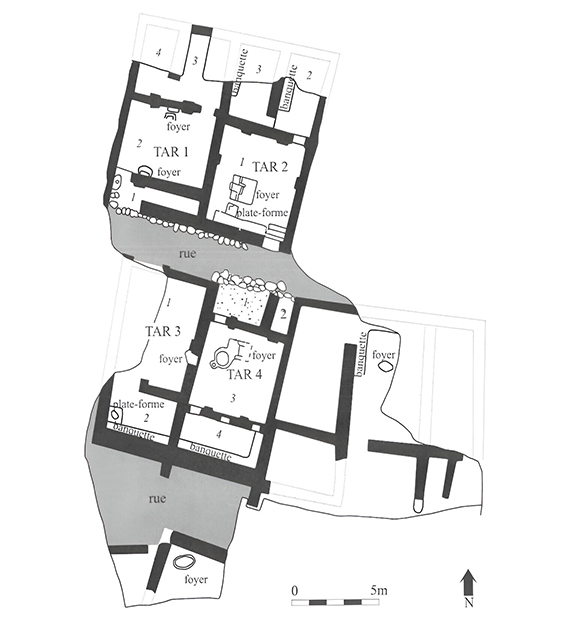
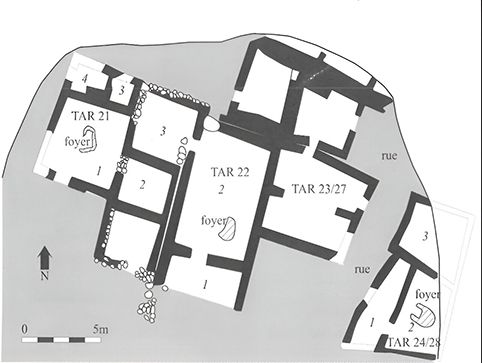
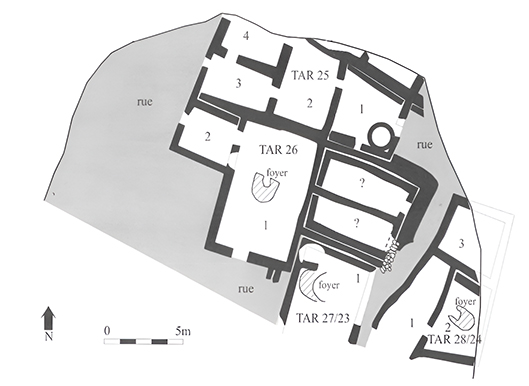
Figure 8 Tarsus-Gözlü Kule, EB III structures. Perello 2011, fig. 156
Figure 9 Tarsus-Gözlü Kule, EB VIB, Phase C-II. Perello 2011, fig. 161
Figure 10 Tarsus-Gözlü Kule, EB VIB, Phases C-III/IV. Perello 2011, fig. 162
5 Analysis of the Architectural Elements in Cyprus and Cilicia
The significance of analysing the architectures and domestic elements distinctive of the Philia facies in Cyprus lies in the possibility that these elements may have been influenced by Anatolian culture. This examination helps to understand the interaction between Anatolian groups and the local components. The following elements will be considered: a) the organisation of the structures; b) the construction techniques; c) the presence and location of fire installations and workbenches.
The better-preserved Philia architectures are found at Marki-Alonia (Phase B), and at Sotira Kaminoudhia. There is interesting evidence concerning the post-Philia evolution, with structures referred to period EC I. Both at Marki (Phase B) and Sotira (EC I) architectures are rectilinear,158 clustered and closely spaced. At Marki two or three rooms surround a court, likely used for food preparation, where pits159 and fire installations are visible. In Phase B courts are not delimited, only in the following periods (EC I-II, Phases C and D) there is a wall delimitation of the space. No open spaces can be identified at Sotira, and rooms are collectively accessible.160
158 At Sotira more extravagant plans are present as well. For Example, Unit 6 and 40 (Area A), trapezoidal, and Unit 8 (Area C), triangular.
159 Pits were probably used both for waste disposal and for storage. Papacostantinou 2013, 139-40.
160 Most units are single rooms; some divided later into interconnected rooms with a single entrance, such as Units 1-3 and 40-7-18.
In Cilicia, Kinet-Höyük and Tarsus-Gözlü Kule provide key insights. Kinet’s EB II structures (Phase VI.4) resemble Marki Phase B, featuring rooms arranged around a court. However, this layout appears to gradually diminish in significance during EB III (Phase VI.3, Period 24), with a reduced emphasis on open spaces.161 Limited EB IVA evidence suggests a shift towards imposing residential structures in EB IVB, indicating social changes.
161 The court was likely abandoned due to a greater need to define private property, as it constituted a communal space.
Tarsus EB III structures are tripartite or bipartite (see above), and have precise rectangular plans, which no change in EB IVA (Phases A and B), but only a reduced room hierarchy. In EB IVB (Phase C), Tarsus structures cluster randomly, with some open spaces lacking communal features.
Construction techniques employed in Cyprus and Anatolia appear to be very similar. The evidence of walls consists of a stone plinth upon which the mudbrick walls were constructed. In Cyprus, residential structures primarily exhibit plaster floors162 with stone foundations supporting the mudbrick walls.
162 These architectural elements are often subject to later alterations for the construction of other domestic features such as hearths, ovens, and pits.
During the EC I period, changes are observed in Sotira, particularly in the emergence of a distinct construction technique and a different functionality associated with walls thickness (see above). Similarly, Cilician contexts provide a homogeneous picture and with greater evidence of the use of plaster for wall coverings.163 Plaster could serve various functions: structural, functional, and aesthetical.164 Regarding floor preparations, only some contexts (Kilise-Tepe, Kinet-Höyük, and partially Tarsus) have provided information on these elements. Only at Tarsus during the EB IVA preparations made of stones were found as support to more imposing structures.
163 The plaster used in these contexts is not always the same, varying based on the locally available materials, typically consisting of a gypsum or calcite-based mixture. An evolution of this trend is evident at the site of Kinet-Höyük, Phase VI.1 (=EB IVB), where walls entirely constructed from local stone are found.
Similar to Cyprus, the floorings have a plaster coating, which is often more explicitly connected to the plaster on the walls, especially at Kinet.
164 The structural function is seen especially where wall covering is closely connected with flooring, creating a more compact and solid structure. This functional aspect makes the structure more impermeable. The aesthetic of plaster coverings is enhancing the visual appeal of the wall itself.
The analysis of domestic elements, including hearths/ovens and workbenches in Cyprus and mentioned Anatolian contexts reveals similarities. In Cypriot contexts, fire installations generally have rectangular or circular shapes. Circular hearths are consistently found across the examined periods (Late Chalcolithic, Philia, and EC I-II), while rectangular fire installations are distinctive of the Philia facies.165 This shift in form is seen as an adaptation to rectilinear plans,166 emphasising the functional aspect and diminishing the symbolic value as a family gathering point. At Kissonerga-Mosphilia (Periods 4 and 5), there is a notable shift of hearths from the interior to the exterior of structures. This change may be linked to a difference in use during Period 5, when installations accommodate larger groups, leading to their placement in more accessible areas.
165 Only sporadic findings are attributed to EC I-II at Marki and Sotira.
166 There is a shift of installations towards the walls during the Philia facies, in contrast to the central position occupied by circular hearths during the Late Chalcolithic period.
Cilician hearths, especially in Tarsus, exhibit a heterogeneous character during the EB III. Unlike Cypriot contexts, Tarsus hearths vary in shape167 and location within houses: 1) close to walls; 2) centrally positioned; 3) slightly off-centre near entrances. Those located near walls are often associated with workbenches, suggesting a domestic focus on food preparation. Centrally placed hearths suggest a primary function for illumination and warmth. The third placement, slightly off-centre and near the entrance, facilitates a continuous passage between the main room and the rear chamber.168 In Tarsus (EB III), some hearths with shoulders are discovered, designed to support spits for food preparation and suggesting a different use of the hearth itself.169
167 Hearths in Cilicia generally have circular shapes, with only one rectangular hearth (FI 98/5) identified in the levels corresponding to Phase Vg at Kilise-Tepe.
168 The hearth, positioned along an imaginary path, was accessible without hindering movement within the dwelling.
169 The presence of the shoulder meant that only a portion of the hearth was ‘open’ and accessible to individuals.
At Tarsus in EB III workbenches made of plaster are found, which appear to be in close relation with the hearth or in an adjacent, but separate, room. This latter solution and the placement of workbenches along the walls, resemble the evidence found at Sotira-Kaminoudhia during EC I.
5.1 Discussion
Following the comparison of architectural elements, the markers of the Philia facies found in Anatolia include rectilinear plans, the presence of open spaces, the use of mudbricks, the application of plaster coatings, and the presence of hearths and workbenches [tab. 4]. The arrangement of rooms around a court is observed at both Marki-Alonia and Kinet-Höyük. Open spaces are later delimited, possibly due to the emergence of dominant groups. Structures at both areas exhibit rectilinear plans, composed of two or three rooms with a single entrance, typically located in the corner, facing the main road of the settlement (if existing) and identifiable by the presence of a step. Tarsus reveals some tripartite structures, preceded by a portico, representing a distinctive variant which is entirely absent in Cyprus. Both areas feature mudbricks walls with stone plinths, while the use of plaster coatings for walls and floor preparations is more pronounced in Cilicia (Tarsus), while in Cypriot contexts, only fragments of such coverings are found (Marki-Alonia). Regarding fire installations, a notable distinction is evident: rectangular hearths appear to be characteristic of the Philia facies in Cyprus whereas, on the contrary, at the beginning of EC I, only few samples are found within Sotira structures.
In Anatolian contexts hearths are best preserved in Tarsus. However, no modifications in their shape are identified, with the majority characterised by a circular shape, and only few rectangular examples. A consistent feature in Cilicia concerns the placement of hearths inside the rooms: they are generally leaning against the walls and associated with workbenches located in the same or in adjacent rooms for domestic activities. In Cypriot contexts, the position of workbenches is more challenging to analyse, and only Sotira provides some evidence from the beginning of EC I.170 The separation and yet strong proximity between hearths and workbenches, observed in both Cyprus and Cilicia, may suggest a functional distinction within the house. The room with the hearth was likely designated for cooking and heating, while the space with the work bench was used for more practical activities, probably focused on food preparation for subsequent cooking on the hearth.
170 In most cases, workbenches are placed in the adjacent space to the room with the hearth, and they may have the same extension as the wall to which they are attached (Units 1-3, Unit 19), a feature also observed in Tarsus during EB II (Rooms 116, 117, and 115).
6 Conclusions
Architectural evidence in Cyprus and Cilicia reveals notable similarities in rectilinear plans and external architectural features, particularly room organisation, and construction techniques for walls and floors.
It can be hypothesised that the Philia period, marked by the arrival of Anatolian groups, likely influenced architectures in Cyprus. Significant external changes occurred in Cypriot houses, and internal domestic elements also evolved, notably with the introduction of ‘Philia-style’ rectangular hearths. These hearths moved from central positions, typical during the Late Chalcolithic period, to locations next to walls during the Philia period. This shift reflects local adaptations to changes in the house plans. Interestingly, these transformations (shape and placement of hearths) do not directly align with Anatolian origins, evident in the shape and placement variability in Cilician hearths.171 Tarsus, however, presents a relevant analogy with Cyprus, notably in the separation of hearths and workbenches,172 suggesting functional distinctions within houses in both areas. Building upon Frankel, Webb, and Eslick’s hypothesis173 (see above), it is proposed that first Anatolian adult males arrived in Cyprus exploring the island.174 With the beginning of EB IVA in Anatolia and the emergence of the Philia facies in Cyprus, newcomers became part of Cypriot communities and established relationships with local women. This integration led to the development of innovative floor plans175 while still maintaining traditional Cypriot internal organisation. As the Cyprus-Cilicia relationship solidified, it is possible that some Anatolian families settled on the island, allowing the transmission of artisanal knowledge, particularly metalwork, ceramic production, and wheelmaking (see above). This contributed to the emergence of characteristic elements of Philia material culture. The arrival of family groups from Cilicia could account for the presence of Anatolian female individuals, further suggested by the appearance in Cyprus of biconical spindle whorls and a new spinning technique, low whorl spinning, already documented in Anatolia (see above). Significant changes are evident in external architectural features, typically built by men, compared to minimal alterations in internal elements, more closely related to feminine (Cypriot) activities.176
171 Only one example of a rectangular hearth is found in Kilise-Tepe, Phase Vg.
172 Rarely do work benches appear in proximity to hearths; instead, they are mostly situated in an adjacent space near the room with the hearth.
173 Frankel, Webb, Eslick 1996, 37-41; Frankel 2000, 170-9; 2005, 19-24.
174 Frankel 2000, 179-84; 2005, 22.
175 Frankel, Webb, Eslick 1996, 45-6; Frankel 2000, 175; 2005, 22.
176 The ethnographic study by B.J. Parker and M. Bariş between 2000 and 2007 proposes that domestic features (hearths, ovens, tannurs) are generally constructed by women, given the fact that these domestic activities are carried out by the female part of the community. They conducted studies in some villages of Eastern Turkey, examining the construction of hearths and tannurs to compare modern evidence with Turkish archaeological remains (Parker 2011).
Cypriot communities demonstrated receptiveness to change in material culture, but preserved traditions, especially in domestic activities and food preparation. Funerary and sacred practices, influenced by Anatolian components, were evident in necropolises, notably in the frequent occurrences of Red Polished pottery which strongly resembles Anatolian shapes.177 This concentration of status symbol objects within the tombs of Philia culture suggests the establishment of an Anatolian elite class, asserting power through acquiring and redistributing copper objects and agricultural surplus.178 A greater social complexity emerged later, with the need to define private property – a phenomenon visible both in Cyprus and in Cilicia – highlighted by the delimitation of open spaces.
177 Bachhuber 2014, 142-3; Peltenburg 2007, 142-51.
178 Especially ceramics, metal items, and ring pendants. The agricultural surplus was possible thanks to the introduction of the plough.
With the transition from Philia to EC I, Anatolian influence decreased, leading to regionalism and distinct solutions within the same island. Generations later, Anatolian groups became less connected to the mainland, integrating more into Cypriot communities.
Only later, with the beginning of the Middle Cypriot period, Cyprus will open up to trade and re-establish relations with Anatolia and other regions of the eastern Mediterranean and Aegean, to become, between the Middle Cypriot III and the Late Cypriot I, one of the major copper exporters.
The comparison of architectural structures in Cyprus and Cilicia, respectively associated with the Philia facies and the EB IV, allows the examination of a somewhat neglected category of evidence. The Philia facies, in spite of being a rather elusive period, proves to be of significant relevance in understanding the transition to the Bronze Age on the island. It is hoped that future opportunities for in-depth investigations into these findings will arise.
|
Site |
Phase/Area |
Building techniques |
Domestic features |
|
|---|---|---|---|---|
|
Cyprus |
Kissonerga-Mosphilia |
Period 4a-b |
Inner circular hearths |
|
|
Period 5 |
Plaster floors |
Inner circular hearths + oval oven |
||
|
Kissonerga-Skalia |
Area D |
Stone plinths walls + plaster floors |
||
|
Marki-Alonia |
Phase A-B |
Mudbricks walls on stone plinths |
Rectangular hearths |
|
|
Phase C |
Plastered floors |
Circular hearths + plaster workbenches |
||
|
Phase D |
Circular hearths + plaster workbenches |
|||
|
Sotira-Kaminoudhia |
Area A |
Stone plinths walls + plaster floors |
Rectangular hearths + plaster workbenches |
|
|
Area B |
Stone plinths walls |
Double hearth |
||
|
Area C |
Stone plinths walls |
Plaster workbenches |
||
|
Anatolia |
Kilise Tepe |
Phase Vf |
Mudbrick walls on stone plinths + plaster floors |
Circular hearth |
|
Phase Ve |
Stone plinths walls |
Circular hearths |
||
|
Kinet-Höyük |
Phase VI.3, Period 24 |
Stone plinths walls |
||
|
Phase VI.2, Periods 23-22 |
Stone plinths walls |
|||
|
Phase VI.1, Periods 21-19 |
Stone walls |
|||
|
Mersin Yumuktepe |
Level XIIb |
Central hearth with spits + oval oven |
||
|
Level XIIa |
Mudbricks walls |
|||
|
Tarsus-Gözlu Küle |
EB III |
Circular hearths + oval oven + workbench |
||
|
EB IVA |
Mudbricks walls on stone plinths |
|||
|
EB IVB |
Mudbricks walls on stone plinths |
Circular hearths |
Bibliography
Bachhuber, C. (2014). “The Anatolian Context of Philia Material Culture in Cyprus”. Knapp, A.B.; Van Domellen, P. (eds), The Cambridge Prehistory of the Bronze and Iron Age Mediterranean. Cambridge: Cambridge University Press, 139-56.
http://dx.doi.org/10.1017/cho9781139028387.012
Blue, L.K. (1997). “Cyprus and Cilicia: the Tipology and Palaeogeography of Second Millennium Harbors”. Hohlfelder R.L.; Swiny H.W. (eds), Res maritimae: Cyprus and the Eastern Mediterranean from Prehistory to Late Antiquity = Proceedings of the Second International Symposium ‘Cities on the Sea’ (Nicosia, Cyprus, October 18-22 1994). Atlanta (GA): Scholars press, 31-43.
Bolger, D. (2007). “Cultural Interaction in the 3rd Millennium BC Cyprus: Evidence of Ceramics”. Antoniadou, S.; Pace, A. (eds), Mediterranean Crossroads. Oxford: Pierides Foundation, 163-88.
Bombardieri, L.; Graziadio, G. (2019). Cipro. Preistoria di un’isola mediterranea. Firenze: Mondadori Università.
Crewe, L. (2014). “A Reappearing Early Bronze Age in Western Cyprus”. Webb, J.M. (ed.), Structure, Measurement and Meaning. Studies on Prehistoric Cyprus in Honour of David Frankel. Studies in Mediterranean Archaeology. Uppsala: Åström’s Forlag, 137-50.
Crewe, L. (2015). “Expanding and Shrinking Networks of Interaction: Cyprus c. 2200 BC”. 2200 BC – A Climatic Breakdown as a Causa for the Collapse of the World? = 7th Archaeological Conference of Central Germany (Halle, Saale, October 23-26, 2014). Halle: Landesamt für Denkmalpflege und Archäologie Sachsen-Anhalt, Landesmuseum für Vorgeschichte, 131-48.
Dikaios, P. (1946). “Early Copper Age Discoveries in Cyprus: 3rd Millennium B. C. Copper-Mining”. The Illustrated London News, 2 March, 244-5.
Dikaios, P.; Stewart, J.R. (1962). The Stone Age and the Early Bronze Age in Cyprus. Swedish Cyprus Expedition. Vol. 4, 1A. Lund: The Swedish Cyprus Expedition.
Frankel, D. (1998). “Constructing Marki Alonia: Reflections on Method and Authority in Archaeological Reporting”. Journal of Mediterranean Archaeology, 11, 242-56.
http://dx.doi.org/10.1558/jmea.v11i2.242
Frankel, D. (2000). “Migration and Ethnicity in Prehistoric Cyprus: Technology as Habitus”. European Journal of Archaeology, 3, 167-87.
http://dx.doi.org/10.1177/146195710000300202
Frankel, D. (2005). “Becoming Bronze Age. Acculturation and Enculturation in Third Millennium BC Cyprus”. Clarke, J. (ed.), Archaeological Perspectives on the Transmission and Transformation of Culture in the Eastern Mediterranean. Oxford: Council for British Research in the Levant and Oxbow Books, 18-24. Levant Supplementary Series 2.
Frankel, D.; Webb, J.M. (1996). Marki Alonia: An Early and Middle Bronze Age Town in Cyprus. Excavations 1990-1994. Jonsered: Paul Aströms Förlag. Studies in Mediterranean archaeology 123/1.
Frankel, D.; Webb, J.M. (2004). “An Early Bronze Age Shell Pendant from Cyprus”. Bulletin of the American Schools of Oriental Research, 336, 1-9.
http://dx.doi.org/10.2307/4150084
Frankel, D.; Webb, J.M. (2006). Marki Alonia: An Early and Middle Bronze Age Settlement in Cyprus. Excavations 1995-2000. Sävedalen: Paul Aströms Förlag. Studies in Mediterranean archaeology 123/2.
Frankel, D.; Webb, J.M.; Eslick, C. (1996). “Anatolia and Cyprus in the Third Millennium B.C.E.: A Speculative Model of Interaction”. Bunnens, G. (ed.), Cultural Interaction in the Ancient Near East. Papers Read at a Symposium Held at the University of Melbourne, Department of Classics and Archaeology (29-30 September 1994). Louvain: Peeters Press, 37-50. ABR-Nahrain Suppl.
French, E. (2013). “Cilicia”. Killebrew, A.E.; Lehmann, G. (eds), The Philistines and Other “Sea Peoples” in Text and Archaeology. Atlanta: Society of Biblical Literature, 479-83.
http://dx.doi.org/10.2307/j.ctt46n483.22
Gates, M.H. et al. (2015). “Excavations at Kinet-Höyük and Hisn al-Tinat”. Özfirat, A.; Uygun, Ç. (eds), Hatay Arkeolojik Kazı ve Araştırmaları. Antakya: Mustafa Kemal Üniversitesi, 157-71.
Garstang, J. (1937). “Exploration in Cilicia: The Neilson Expedition. Preliminary Report”. Annals of Archaeology and Anthropology, 24, 52-64.
Garstang, J. (1953). Prehistoric Mersin, Yümük Tepe in Southern Turkey. The Neilson Expedition in Cilicia. Oxford: Clarendon Press.
Gjerstad, E. (1934). “Cilician Studies”. Revue Archéologique, Sixième Série, 3, 155-203.
Goldman, H. (1956). Excavation at Gözlü Kule, Tarsus. Vol. 2, From the Neolithic through the Bronze Age. Princeton (NJ): Princeton University Press.
Gordon, T. (2005). “House Form and Cultural Identity in Chalcolithic Cyprus”. Clarke, J. (ed.), Archaeological Perspectives on the Transmission and Transformation of Culture in the Eastern Mediterranean. Oxford: Council for British Research in the Levant and Oxbow Books, 118-24. Levant Supplementary Series 2.
Greaves, A.M.; Helwing, B. (2001). “Archaeology in Turkey: The Stone, Bronze and Iron Ages, 1997-1999”. American Journal of Archaeology, 105, 463-511.
http://dx.doi.org/10.2307/507365
Harris, J. (ed.) (1990). Cyprus Before the Bronze Age: Art of the Chalcolithic Period. Malibu: The J. Paul Getty Museum.
Knapp, A.B. (2008). Prehistoric and Protohistoric Cyprus: Identity, Insularity and Connectivity. Oxford: Oxford University Press.
https://doi.org/10.1093/acprof:oso/9780199237371.001.0001
Knapp, A.B. (2013). The Archaeology of Cyprus: From Earliest Prehistory Through the Bronze Age. Cambridge: Cambridge University Press.
Knapp, A.B. et al. (1990). “Production, Location and Integration in Bronze Age Cyprus”. Current Anthropology, 31, 147-76.
http://dx.doi.org/10.1086/203819
Kouka, O. (2009). “Cross-Cultural Links and Elite-Identities: The Eastern Aegean/Western Anatolia and Cyprus from the Early Third Millennium Through the Early Second Millennium BC”. Karageorghis, V.; Kouka, O. (eds), Cyprus and East Aegean: Intercultural Contacts from 3000 to 500 BC = Proceedings of the International Archaeological Symposium (Pythagoreion Samos, 17-18 October 2008). Nicosia: A.G. Leventis Foundation; German Archaeological Institute at Athens, 31-47.
Kozal, E. (2016). “Cypro-Anatolian Connections in the 2nd Millennium BC”. Summerer, L.; Kaba, H. (eds), The Northern face of Cyprus, New Studies in Cypriot Archaeology and Art History. Istanbul: Ege Yayinlari, 51-64.
Manning, S.W. (1993). “Prestige, Distinction and Competition: The Anatomy of Socioeconomic Complexity in IV to II Millennium BCE”. Bulletin of the American Schools of Oriental Research, 292, 35-58.
http://dx.doi.org/10.2307/1357247
Matthiae, P. (2013). “The IIIrd Millennium in North-Western Syria: Stratigraphy and Architecture”. Orthmann, W.; Matthiae, P.; Al-Maqdissi, M. (éds), Archéologie et histoire de la Syrie. Vol. 1, La Syrie de l’époque néolithique à l’âge du fer. Wiesbaden: Harrassowitz, 181-98. Schriften Zur Vorderasiatischen Archäologie 1.
http://dx.doi.org/10.4000/syria.2305
Mellaart, J. (1962). The Cambridge Ancient History. Vol. 1, Anatolia c. 4000-2300 BC. Cambridge: Cambridge University Press.
Mellink, M.J. (1965). “Excavations at Karataş-Semayiik in Lycia, 1964”. American Journal of Archaeology, 69, 241-51.
http://dx.doi.org/10.2307/502289
Mellink, M.J. (1972). “Archaeology in Asia Minor”. American Journal of Archaeology, 76, 165-88.
http://dx.doi.org/10.2307/503860
Mellink, M.J. (1991). “Anatolian Contacts with Chalcolithic Cyprus”. Bulletin of the American Schools of Oriental Research, 282-3, 167-75.
http://dx.doi.org/10.2307/1357270
Novák, M. et al. (2017). “A Comparative Stratigraphy of Cilicia”. Altorientalische Forschungen, 44, 150-86.
http://dx.doi.org/10.1515/aofo-2017-0013
Papaconstantinou, D. (2013). “Settlement Planning and Architecture”. Peltenburg, E. (ed.), Cyprus, ARCANE (Associated Regional Chronologies for the Ancient Near East and the Eastern Mediterranean), vol. 2. Turnhout: Brepols, 129-60.
Paraskeva, C. (2017). “Disentangling Past Narratives: A Reconsideration of Fyllia (Philia) Drakos Sites B and C”. Pilides, D.; Mina, M. (eds), Four Decades of Hiatus in Archaeological Research in Cyprus: Towards Restoring the Balance = Proceedings of the International One-Day Workshop Held in Lefkosia (Nicosia) on 24th September 2016. Vienna: Verlag Holzhausen GmbH, 72-9. Studies on Ancient Cyprus 2.
Parker, J.B. (2001). “Bread Ovens, Social Networks and Gendered Space: An Ethnoarchaeological Study of Tandir Ovens in Souheastern Anatolia”. American Antiquity, 76, 603-27.
http://dx.doi.org/10.7183/0002-7316.76.4.603
Peltenburg, E.J. (1982). “Aspects of the Transition to the Bronze Age”. Peltenburg, E.J. (ed.), Recent Developments in the Later Prehistory of Cyprus. Göteborg: Paul Astroms Forlag, 91-103.
Peltenburg, E.J. (1991). “Kissonerga-Mosphilia: A Major Chalcolithic Site in Cyprus”. Bulletin of the American Schools of Oriental Research, 282-3, 17-35.
http://dx.doi.org/10.2307/1357260
Peltenburg, E.J. (1993). “Settlement Discontinuity and Resistance to Complexity in Cyprus, ca. 4500-2500 B.C.E.”. Bulletin of the American Schools of Oriental Research, 292, 9-23.
http://dx.doi.org/10.2307/1357245
Peltenburg, E.J. (1998). Lemba archaeological project. Vol. II.1A, Excavation at Kissonerga-Mosphilia, 1979-1992. Jonsered: Paul Aströms Förlag. Studies In Mediterranean Archaeology 70/2.
Peltenburg, E.J. (2007). “East Mediterranean Interactions in the 3rd millennium BC”. Antoniades, S.; Pace, A. (eds), Mediterranean Crossroads. Oxford: Pierides Foundation, 141-61.
Peltenburg, E.J. (2013). Cyprus, ARCANE (Associated Regional Chronologies for the Ancient Near East and the Eastern Mediterranean), vol. 2. Turnhout: Brepols.
Perello, B. (2011). L’architecture domestique de l’Anatolie au IIIe millénaire av. J.-C. Istanbul: Institut Français d’études Anatolienne-Georges Dumézil. Varia Anatolica 24.
Postgate, J.N. (1998). “Between the Plateau and the See: Kilise Tepe 1994-1997”. Matthew, R. (ed.), Ancient Anatolia: Fifty Years’ Work by the British Institute of Archaeology at Ankara. London: BIAA, 127-41.
Postgate, J.N.; Thomas, D. (2007). Excavations at Kilise Tepe 1994-98: From Bronze Age to Byzantine in western Cilicia. Vol. 1, Text. Cambridge; London: McDonald Institute for Archaeological Research; British Institute at Ankara. BIAA Monograph 30.
Schaar, K.W. (1985). “House Form at Tarsus, Alambra, and Lemba”. Report of the Department of Antiquities Cyprus, 37-44.
Şerifoğlu, T.E. (2019). “Kilise Tepe in Rough Cilicia before the Late Bronze Age: An Overview of the Architecture, Pottery Traditions, and Cultural Contacts”. Kahya, T. (ed.), ADALYA. The Annual of the Koç University Suna & İnan Kıraç Research Center for Mediterranean Civilizations. Istanbul: Koç University, 69-100.
Seton-Williams, M.V. (1954). “Cilician Survey”. Anatolian Studies, 4, 121-74.
http://dx.doi.org/10.2307/3642378
Steadman, S.R.; McMahon, G. (2015). The Archaeology of Anatolia: Recent Discoveries (2011-2014), vol. 1. Newcastle upon Tyne: Cambridge Scholars Publishing.
Steel, L. (2004). Cyprus Before History: From the Earliest Settlement to the End of the Bronze Age. London: Duckworth.
Swiny, S. (1985). “Sotira-Kaminoudhia and the Chalcolithic/Early Bronze Age Transition in Cyprus”. Karageorghis, V. (ed.), Archaeology in Cyprus 1960-1985. Nicosia: A.G. Leventis Foundation, 115-24.
Swiny, S. (1989). “From Round House to Duplex: A Re-Assessment of Prehistoric Cypriot Bronze Age Society”. Peltenburg, E. (ed.), Early Society in Cyprus. Edinburgh: Edinburgh University Press, 14-31.
Swiny, S. (2008). “Of Cows, Copper, Corners, and Cult: The Emergence of the Cypriot Bronze Age”. Near Eastern Archaeology, 71, 41-51.
http://dx.doi.org/10.1086/nea20361347
Swiny, S.; Rapp, G.; Herscher, E. (2003). Sotira Kaminoudhia. An Early Bronze Age Site in Cyprus. Boston: American Schools of Oriental Research. Cyprus American Archaeological Research Institute Monograph Series 4.
http://dx.doi.org/10.5615/j.ctt2jc9wt
Wawruschka, C. (2010). “Regional Analysis of the Prehistoric Cilician Plain: Geopolitical and Socio-Economic Aspects of Settling”. Matthiae, P. et al. (eds), Proceedings of the 6th International Congress on the Archaeology of the Ancient Near East (“Sapienza” Università di Roma, May, 5-10, 2008), vol. 1. Wiesbaden: Harrassowitz, 579-90.
Webb, J.M. (2009). “Keeping House: Our Developing Understanding of the Early and Middle Cypriot Household (1926-2006)”. Houby-Nielsen, S. (ed.), Finds and Results from the Swedish Cyprus Expedition 1927-1931: A Gender Perspective. Stockholm: Medelhavsmuseet, 255-67.
Webb, J.M. (2013). “Changing Technological and Social Environments in the Second Half of the Third Millennium BC in Cyprus”. Frankel, D. et al. (eds), Archaeology in Environment and Technology: Intersections and Transformations. New York: Routledge, 135-48.
Webb, J.M.; Frankel, D. (1999). “Characterizing the Philia Facies: Material Culture, Chronology, and the Origin of the Bronze Age in Cyprus”. American Journal of Archaeology, 103, 3-43.
http://dx.doi.org/10.2307/506576
Webb, J.M.; Frankel, D. (2000). “Marki Alonia: A Prehistoric Bronze Age Settlement in Cyprus”. Parker, B.J.; Foster, C. (eds), New Perspectives on Household Archaeology. Winona Lake (IN): Eisenbrauns, 473-500.
http://dx.doi.org/10.1017/s0003598x00060336
Webb, J.M.; Frankel, D. (2008). “Fine Ware Ceramics, Consumption and Commensality: Mechanism of Horizontal and Vertical Integration in Early Bronze age Cyprus”. Hitchcock, L.A.; Laffineur, R.; Crowley, J.L. (eds), Dais. The Aegean Feast. Liège: Université de Liège, 287-300. Aegaeum 29.
Webb, J.M.; Frankel, D. (2011). “Hearth and Home as Identifiers of Community in Mid-Third Millennium Cyprus”. Karageorghis, V.; Kouka, O. (eds), On Cooking Pots, Drinking Cups, Loomweights and Ethnicity in Bronze Age Cyprus and Neighbouring Regions = International Archaeological Symposium (Nicosia, November 6-7, 2010). Nicosia: A.G. Leventis Foundation, 29-42.
Webb, J.M.; Frankel, D. (2013). “Cultural Regionalism and Divergent Social Trajectories in Early Bronze Age Cyprus”. American Journal of Archaeology, 117, 59-81.
http://dx.doi.org/10.3764/aja.117.1.0059
Yener, K.A.; Vandiver, P.B. (1993). “Tin Processing at Göltepe, an Early Bronze Age Site in Anatolia”. American Journal of Archaeology, 97, 207-38.